How To Create Urgency When Buyers Are Fine With “Good Enough”

This topic is a great one: urgency. People are interested in your product, but they are not buying. Not now. But why not? And how can you create urgency? Today we’ll walk through a framework you can use directly, inspired by the great sales leader and trainer Jen Allen-Knuth aka DemandJen.
Your messaging is clear. Your product is better. You’ve got the case studies to prove it. People are interested. But they aren’t buying.
Why not?
Because they don’t think they have a problem. Their current way of doing things is “good enough.” Even when it’s costing them time, money, or sanity.
That is your enemy. GOOD ENOUGH.
Most marketers try to prove they’re better. But “better” doesn’t create urgency.
Showing prospects what staying put is costing them does.
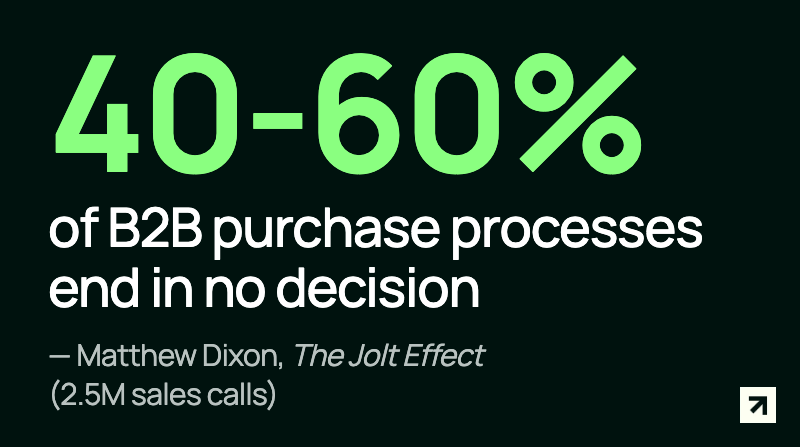
40-60% of B2B purchase processes end in no decision. Those opportunities are lost to the status quo. Not to competitors, not to budget, but simply to “we’re fine for now.”
That’s the problem Jen helped us solve; and I think it’s extra important (it’s my newsletter I can say that) because she is coming at it from the sales side of the house. Not from our marketing ivory tower.
Why “Better” Doesn’t Win
Think about the last time you bought something for work. Did you immediately switch to the better option? Or did you stick with what you had because change felt risky, expensive, or just exhausting?
Your buyers are doing the same thing.
Jen used a simple example: a $100 packable raincoat versus a free umbrella.
The raincoat is objectively better. Hands-free. Fits in your bag. Won’t flip inside out in the wind.
But the umbrella costs $0. And most people already own two!
So they stick with the umbrella. Even though they forget it 95% of the time and end up paying $40 for surge-priced Ubers when it rains.
That’s your buyer (and probably you!). Rationally, your solution makes sense. Emotionally, they’re not motivated to change.
So stop trying to prove you’re better. Start showing them what staying put is costing them.
The “We-We” Problem (And How To Fix It)
^ how great is that headline? We can’t take credit for that one, it’s all Jen. You need to stop we-we-ing all of your prospects.
Here’s what it means (it’s not about pee you sicko).
Most cold emails look like this:
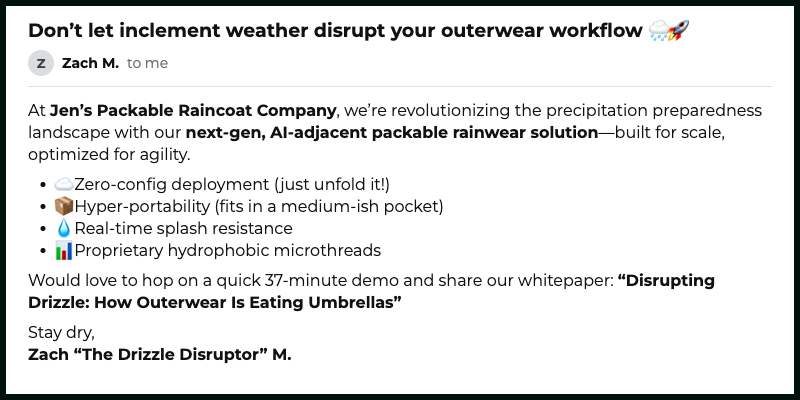
What’s the problem with this email?
It’s all about you. YOUR product. YOUR features. YOUR results.
But your prospect doesn’t care about YOU. They care about themselves (!).
And more importantly, they care about what their peers are doing.
So instead of saying “we offer a better way,” show them what the status quo is actually costing people like them.
Here’s how Jen reframes the packable raincoat pitch:
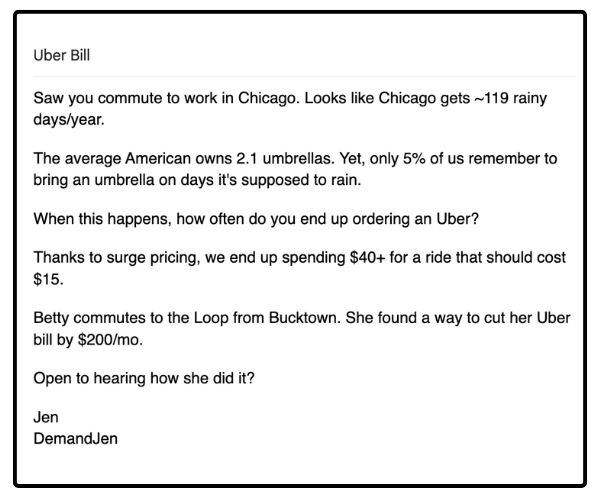
It doesn’t lead with features or a pitch. It’s all about a problem the prospect didn’t realize they had with real numbers.
That’s how you beat status quo.
Jen shared a framework to help you rewrite your messaging around the real problem:
Four Questions That Show B2B Buyers The Cost Of Status Quo 1 Who is most likely to have the problem your solution solves?
Not just your ICP. The specific person inside that ICP who feels the pain every day. This is who your content should speak to. 2 How do those people solve the problem today? Why is that approach “good enough”?
This is your status quo. You need to understand it better than they do. 3 What’s the unintended negative consequence of solving it that way?
This is the cost of inaction. The thing they’re not tracking but should be. This becomes your hook. 4 Who took a different approach?
This is your customer proof. But don’t make your company the hero. Make their peer the hero.
When you answer these four questions, you stop pitching a product and start prompting a problem.
ROI Vs. Cost Of Inaction
One is hypothetical. The other is happening right now.
ROI says: “By doing SOMETHING you MIGHT see this positive return.”
But Cost of Inaction says: “By changing NOTHING, you ARE seeing this negative consequence.”
Guess which one creates more urgency?
Most marketing teams obsess over ROI calculators and case studies. But buyers often don’t move because of the upside. They move because staying put hurts.
Your job is to make that pain as visible and real as possible.
Two $0 Exercises You Can Run This Week
Exercise 1: Closed-Lost Audit
Pull your closed-lost deals from the last quarter. Look at the reason codes.
How many say “no decision,” “timing,” “budget,” or “went with competitor”?
That’s status quo winning.
Now dig deeper with your sales team: What was the actual reason they didn’t buy? Not the polite excuse. The real one.
Most of the time, it’s because they didn’t believe the cost of staying put was higher than the cost of switching.
This tells you exactly where your messaging is falling short.
Exercise 2: Cold Email Audit
Pull the last 10 cold emails your team sent.
Count how many times you say “we” versus “you.”
If it’s more than 2:1, you’ve got a we-we problem.
Then ask: Does this email help the prospect size their status quo problem? Or does it just pitch how great we are?
If it’s the latter, rewrite it using Jen’s four questions.
You don’t need a bigger budget or more tools.