B2B Event Marketing Strategy: G2’s Sold-Out Playbook

A B2B event marketing strategy that works decides what attendees should think, feel and do before, during and after the event. Then it sweats the details: rehearse the content, seat the right people together, measure revenue in the room instead of registrations, and follow up the same night. That’s how G2 sold out a four-city roadshow.

Events can be amazing. Events can also be a place you send budget to die. When they don’t work, people usually blame the channel: “Events are broken.” “ROI is impossible to track.” “Nobody shows up anymore.”
The hard part is that running a good event and running a great event are two completely different games. So what makes people show up, engage and actually convert? And how do you justify the budget when the CFO wants hard numbers?
Sydney Sloan, CMO at G2, broke down how her team runs events that sell out on the Exit Five podcast. Four cities. 250 people each. Sold out at every stop. Not theory, and not what you’d read in an event planning book. Here’s the playbook, phase by phase.
The B2B event playbook at a glance
| Phase | What G2 did | What to measure |
|---|---|---|
| Before | Mapped what attendees should think, feel and do. Marketing personally invited the right people. Ran three full rehearsals. | Who’s registered: the right accounts and roles, not raw registrations |
| During | Seated tables by experience level, put a trained facilitator at every table, and capped sessions at 15 minutes with built-in interactivity. Hosted a VIP event after each city. | Revenue in the room: prospect revenue plus retention revenue |
| After | Dropped leads the same night or first thing the next morning. Sent at least 20 photos within 24 hours with the thank-you. | Speed of follow-up, and the pipeline and retention revenue the event touched |
Before the event: how to plan a B2B event that sells out
Start with what you want them to think, feel and do
Sydney learned this framework years ago from a CMO named Lisa Steele, and she still uses it for every event. It’s a 3×3 grid: before, during and after across the top, and think, feel and do down the side.

Before the event starts, what do you want attendees to think? How do you want them to feel? What action do you want them to take? Then answer the same questions for during and after.
For the AI in Action roadshow, G2 wanted people to think they weren’t too far behind but needed to move now. They wanted them to feel urgency, but also empowered. And they wanted them to leave with a blueprint they could take back and use with their team. That clarity drove everything else.
You can layer the grid by persona too: one for VIPs, one for developers, one for champions. The point is that you’re not just booking venues and planning sessions. You’re designing an experience with specific outcomes in mind.
Get the right people in the room
Marketing took ownership of directly inviting the right people. They didn’t send emails and hope. Sydney was DMing people. Palmer, on her team, was texting. The table you sit at matters, and one disengaged person ruins it for everyone else. G2 even had a way to spot who was there to learn and who showed up for the swag.
Rehearse three times (yes, really)
This is where most events fall apart. G2 ran three full rehearsals before every city, with Sydney sitting in as the emcee and giving direct feedback. Too many slides? Cut them. Saying the same thing as another presenter? Decide who says it. Weak call to action? Rework it.
Every presentation was capped at 15 minutes with built-in interactivity. Attendees started with a blank slate and left with a fully mapped-out workflow and a pre-built prompt they could use right away. Sydney also kept the same presenters across all four cities when she could, so the content got tighter and the experience got better at every stop.
During the event: details are the experience
Here’s something most people miss: G2 assigned tables by experience level. Novices sat with novices and experts sat with experts, so nobody had to explain basics to advanced users or hold back the people who wanted to go deep.
Every table had a trained facilitator who knew their role. They kicked off discussions, made sure one person didn’t dominate, and ran the prompting session at the end.
After each city, G2 also ran a separate VIP event. Sometimes it was a dinner, sometimes a sporting event, sometimes a concert. A Giants baseball game in San Francisco worked best for recruiting and for the overall experience. What matters is that they tested different formats and paid attention to what worked.
One more tip from Sydney for community-style events: run a buddy program on the first night. Pair newcomers with regulars who share something in common, like the same role or industry, and make finding their buddy the first activity. It solves the cliquey problem and means everyone knows at least one person.
After the event: follow up that night
Most people think about events as the event itself. But the value is in the follow-up, and it needs to happen immediately. Sydney drops leads the same night or first thing the next morning. Not two days later. People are still checking their email, and being first shows you’re the kind of partner they want to work with.
G2 also pushes its photographer to turn around at least 20 high-quality photos within 24 hours, so the thank-you email can include a link to a photo library of branded images attendees can share while the event is still fresh. That’s how you get organic social reach that matters. Wait a week and the moment is gone.
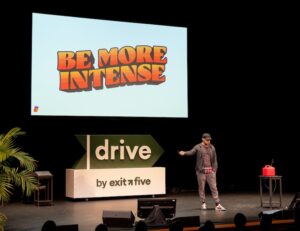
We learned the same lesson when we ran Drive, Exit Five’s conference: the event isn’t over when people leave the venue. We pushed photos, video clips and recap content out the same day or the next morning, while the energy was still real. More of what we learned is in the real ROI of events.
How to measure event marketing ROI: revenue in the room
Sydney’s favorite metric for event ROI is revenue in the room. How much prospect revenue is in the room? How much retention revenue? Existing customers matter as much as prospects, because your happy customers will sell your prospects better than you ever could.
At the New York stop alone, G2 had about $6 million in revenue in the room. By the end of the roadshow, they’d touched over 20% of their total revenue.
That’s a far more useful number to bring to a CFO than registrations, because it ties the event to accounts that matter. Running a booth instead? See what the Exit Five community shared in show me your booth.
What this means for your event strategy
Running great events isn’t about bigger budgets or fancier venues. It’s about being intentional with every detail: knowing what you want attendees to think, feel and do, rehearsing until the content is tight, getting the right people in the room, measuring revenue in the room, and following up fast.
Most events fail because they skip these steps. They wing the content, don’t think about post-event until it’s too late, and hope for the best instead of designing for specific outcomes. G2’s approach isn’t revolutionary, but it is rigorous, and that’s why it works.
- Map your think, feel, do grid for before, during and after.
- Personally invite the accounts and people you most want in the room.
- Rehearse every session, and cap talks with built-in interaction.
- Seat people by experience level, with a facilitator at each table.
- Plan follow-up before the event: leads out that night, photos within 24 hours.
- Report revenue in the room, not registrations.
For more from event leaders on metrics, stakeholder buy-in and post-event follow-up, watch our live session The B2B Event Playbook: Building Revenue-Driving Events.
Want more like this? The Exit Five Newsletter brings you what’s working in B2B marketing right now, with real stats, examples and tools you can take straight back to your team. Join 40,000+ marketers who read it.
Frequently asked questions
What is a good B2B event marketing strategy?
Decide what attendees should think, feel and do before, during and after the event, then design every detail around it. G2 personally invited the right people, rehearsed every session three times, seated tables by experience level, measured revenue in the room, and sent leads to sales the same night. That approach sold out all four stops of its roadshow.
How do you measure event marketing ROI?
Event marketing ROI is best measured as revenue in the room, the metric G2 CMO Sydney Sloan uses: the prospect revenue plus the retention revenue represented by the people who attend. At G2’s New York stop, that was about $6 million, and by the end of the four-city roadshow the events had touched over 20% of G2’s total revenue. It’s a more useful number for a CFO than registrations.
What is the Think, Feel, Do framework for events?
The Think, Feel, Do framework is a 3×3 grid that G2 CMO Sydney Sloan learned from CMO Lisa Steele. The columns are before, during and after the event, and the rows are what you want attendees to think, feel and do at each stage. You can build one grid per persona, such as VIPs, developers or champions, so every session and touchpoint has a specific outcome.
How quickly should you follow up after a B2B event?
Follow up with B2B event leads the same night or first thing the next morning. G2 CMO Sydney Sloan drops leads immediately because attendees are still checking email and being first signals you’re on it. G2 also gets at least 20 high-quality photos back from its photographer within 24 hours, so the thank-you email can link to a branded photo library people want to share.