How to Make Your B2B Brand Stand Out in 2026
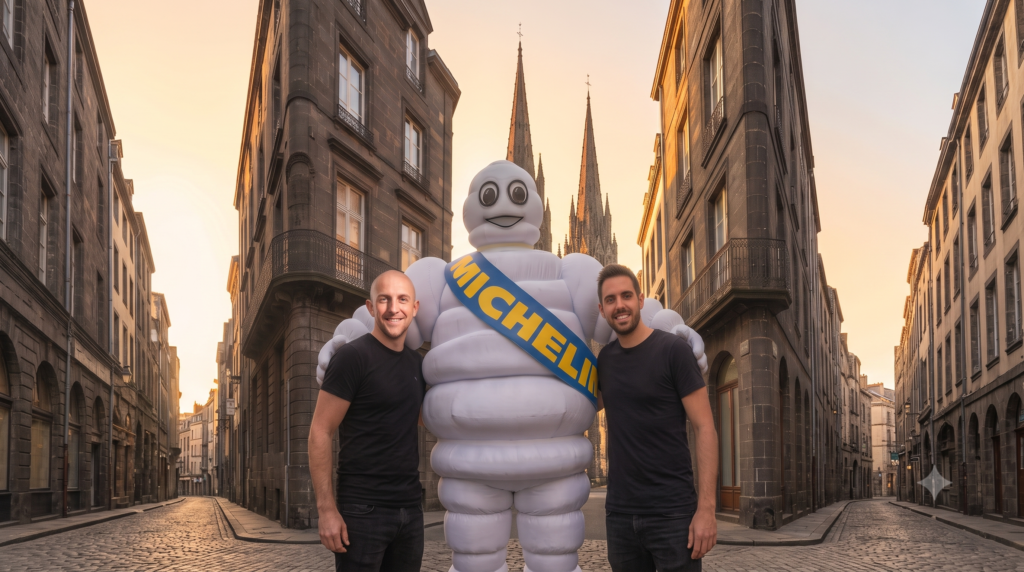
This newsletter is guest written by Louis Grenier, author of Stand The F*ck Out and upcoming Drive keynote speaker.
I spent the better part of May auditing brand marketing for 100 B2B SaaS and AI brands, such as Linear, Notion, Gong, Ramp, or Vanta. Rest assured, I didn’t just do it for fun.
I had a point to prove, because, for more than a decade, I’ve argued that B2B tech brands neglect distinctiveness. I’ve watched companies spend months sharpening their positioning, nailing their ICP, finding a true differentiation that would give the right people a compelling reason to pick them, and then ship a website, a campaign, an identity that’s just… beige as f*ck.
But it was a gut feeling. I had 0 data to prove it. Until now.
Here’s what I did
Inspired by Jenni Romaniuk’s work (and her book Building Distinctive Brand Assets, which I highly recommend), I scored each one on the eight things that actually make a brand distinctive: the logo, a distinctive visual device (like a shape), the tagline, a face (human or not), sound, colour, typography, and a signature product motif. Zero to three on each. Same rubric for everyone.
Each one of those assets is a way to tickle different parts of your buyer’s brain. And the more you have, and the stronger they are, the more likely you surface at the exact moment someone’s deciding.
Finding 1: One company in a hundred is ownable
Out of 100 companies, one reached the ownable band. One. Wiz, at 19 out of 24.
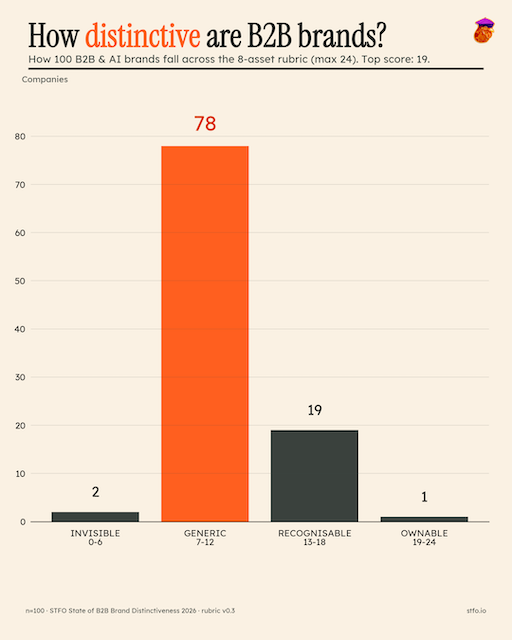
Behind it: 19 companies recognisable, 78 stuck in generic, 2 invisible. The single highest score in the entire study was 19.
The results were even worse than I predicted: 80% of the brands in the sample are beige as f*ck — either generic or just plain invisible. Remove their brand name from their homepage, and most of their prospective customers wouldn’t be able to tell them apart. This is bad… But this is also a MASSIVE opportunity if you’re willing to stand the f*ck out.
Finding 2: The assets that work are the ones nobody touches
Colour scored highest across the cohort, at 2.12 out of 3, with 86% of companies scoring 2 or better. It’s probably the easiest asset class to obsess over. But when every company in your category nails colour, the colours cancel out. A category of distinct blues is still a category of blues.
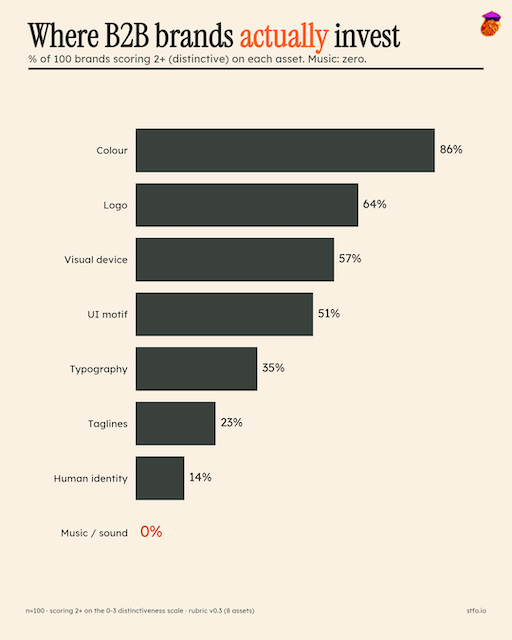
Look at the lowest scoring categories. Human identity, characters, mascots and recurring faces, averaged 0.73. Only 14% of companies managed a 2 or better. Music sat at 0.08. These are the assets Romaniuk’s research keeps finding are the fastest to build recognition: mascots, characters, sonic logos, and distinctive shapes — these are the things that tickle your prospects’ memory the most.
In other words, the assets brands pour the most into are the ones that work the least because everyone pours into them. The assets almost nobody touches are the ones that would actually make you stand the f*ck out.
Finding 3: DevTools takes the risks
DevTools and Infrastructure scored highest, 12.0 on average. Security and GRC (Governance, Risks, Compliance) right behind at 11.86. At the bottom: Data and Analytics, 9.31. Sales and RevOps just ahead at 9.82.
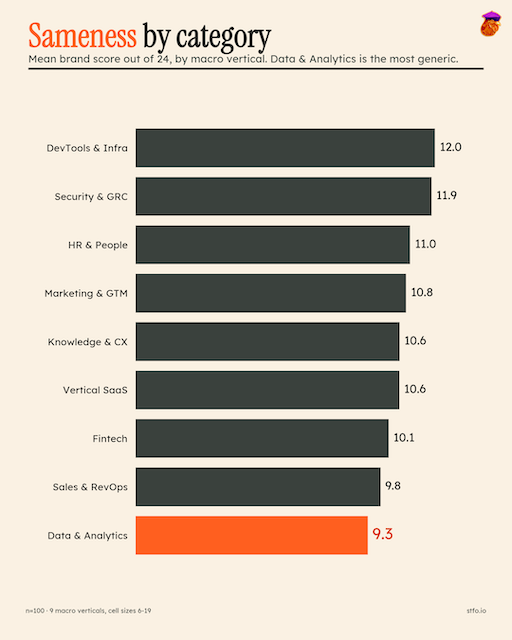
My read? DevTools and security companies sell to developers, and developers are notoriously hard to market to. They’re super cynical about marketing, they live on the web, they’ve seen every play. This means the bar to get noticed by them is higher, and the brands that sell to them seem more willing to take a risk to clear it.
Our sample of 100 companies across 9 verticals is too small to be statistically significant, so don’t read too much into it. But it’s still interesting.
“Cool story… But what now?”
What does this research mean for YOU? I hear you. Here’s my suggestion:
(1) Pick an asset class nobody in your category owns. Look at Finding 2 again. Everyone piles into colour and typography, so those cancel out. The assets that build recognition fastest — sound and human identity — are nearly empty. Not a single brand in the study has a sound.
(2) Commit to one thing that feels slightly too weird. Real distinctiveness is something a competitor can’t comfortably copy, which means it’ll feel like a risk before it works. For example, my hometown of Clermont-Ferrand, in France, is famous for Michelin. (You know, the tire company which also runs a side gig scoring restaurants worldwide.) Anyway, their mascot, Bibendum, is a weird-looking creature made out of white tires. And yet, it’s been barely touched since it first appeared back in… 1898!!
(3) Go at it with sheer intensity. Pick something, obsess over it, show it everywhere. You will get sick of it. Your team will get sick of it. Your CFO will get sick of it. Maybe even some of your customers. Bien. Très bien, even. This means it’s starting to catch on.
So, why doesn’t everyone do this?
If distinctiveness is this powerful, and the bar is this low, why isn’t every B2B company sprinting for it?
(1) Brand work pays slooooowly, so it doesn’t show next quarter. But distinctive assets compound. Every time someone sees/hears/feels a brand asset next to your name, it gets stronger.
(2) It feels like a huge risk because you have to commit BEFORE you can prove it works. And there’s always someone with a lot to lose who’s afraid to put their name on something that looks… not beige.
In short, I believe B2B teams confuse polished with distinctive. And they are not the same thing. Polished gets you a clean, professional, completely generic brand. Distinctive gets you a stand-the-f*ck-out brand that prospects can’t help but notice, remember, and put into their shortlist.
I’m Louis Grenier, author of Stand The F*ck Out and founder of STFO, where we help B2B brands… well, stand the f*ck out. Want to dig deeper? Check out the full State of B2B Brand Distinctiveness 2026 report for all the insights, our top 10 brand rankings, and the full scoring breakdown.
PS – Dave here:
Louis will be taking the stage at Drive this September in Stowe, VT. Grab your ticket to hear more from him about standing out in a sea of sameness.