6 things LinkedIn’s VP of Marketing told me
6 Things I Learned From LinkedIn’s VP of Marketing About B2B Buyers, Ads, What’s Working Right Now
It’s Tuesday March 24, 2026. And if you haven’t figured it out yet, I will try and say it directly: the game has changed.
This is not your mother’s B2B marketing playbook!
70% of B2B buyers are now Gen Z and millennials.
60% of searches are zero-click.
94% of B2B buyers are pulling information from LLMs before they ever talk to sales.
That’s why modern B2B buyers don’t want your eBook. They’re not going to read the whitepaper. And they might not be itching to hang with your sales team at the booth in Vegas in exchange for a $20 gift card. What can $20 get you these days anyway!?
Look: the traditional demand gen engine, rank on Google, drive a click, capture a lead on a landing page, is not going away overnight. But it’s certainly shrinking. And if you’re a marketing leader building your plan for the next 12 months, you have to ask the question: where are your buyers actually forming opinions, building trust, and deciding which vendors make the shortlist?
Increasingly, it’s on LinkedIn. Buyers trust people, not brands. They’re influenced by creators, peers, and employees who show up with real expertise. You can boost an employee’s post as a thought leader ad and target it to your exact ICP. You can test a message organically and put paid behind it the same week. Organic and paid, same platform, same audience. That’s what makes LinkedIn different from every other channel in B2B right now. LinkedIn is not the LinkedIn from 2015 where you’d only use it to connect with someone after a meeting.
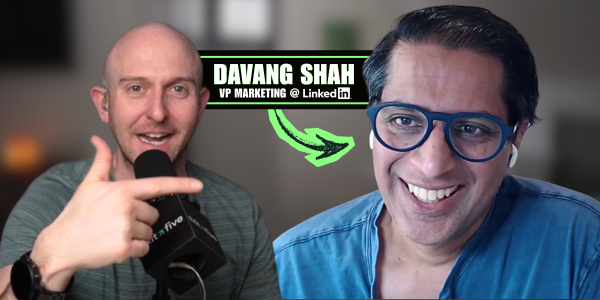
For most of the readers of this newsletter, LinkedIn is the place to be. But there’s a lot of noise out there. So I had a conversation with LinkedIn VP Marketing Davang Shah (he runs marketing for their ads business and spent 17 years at Google in B2B).
I left with a notebook full of stats, and I wanted to recap the highlights here for this edition of my newsletter because I think this maps to what a lot of you are working through right now.
Here are six things that stuck with me (and here’s the full conversation if you want to tune in).
1. The average B2B deal takes 211 days and involves 22 people.
That’s almost seven months. Seven months! But we measure so much of marketing based on what is happening right now and direct response only. And of those 22 people who influence the deal, half are inside the buyer’s org and half are outside. You’re not just selling to a buying committee. You’re selling to their network, the people they trust, the peers they ask for advice. That’s a much bigger surface area than most marketing plans account for.
2. Your buyers aren’t ready to buy right now.
Only 5% of B2B buyers are actively looking to purchase at any given time. Which means the vast majority of your audience isn’t ready to buy today, but they will be at some point over the next 211 days. If you’re only running bottom-of-funnel campaigns, you’re fighting over 5% of the market and ignoring everyone else.
95% of your buyers aren’t ready to buy right now.
Only 5% of B2B buyers are actively in-market at any given time. If you’re only running bottom-of-funnel, you’re fighting over a tiny slice.
3. An ad’s effectiveness comes down to creative.
LinkedIn’s team analyzed thousands of ads and found that creative drives 60-70% of performance. Not targeting. Not budget. The creative! Think about that. And the overproduced stuff doesn’t necessarily win. Davang said authentic, scrappy creative that connects on a human level often performs as well or better than polished agency work. Too often the ads on LinkedIn feel like ads; they feel too “on brand” to stand out.
70% of an ad’s effectiveness comes down to creative.
Not targeting. Not budget. The creative. And the overproduced stuff doesn’t always win.
4. Thought leader ads are getting 2.2x higher click-through rates.
Ads from a person’s profile, not the company page, are generating 2.2x higher CTR compared to single image ads. The pattern keeps repeating: content from real people outperforms content from brand accounts. What’s cool about this ad format is that the content can come from anyone: the CEO, the CMO, a sales guy, a product manager, even a customer. Faces over the company page all day.
5. Test it organic first, then put money behind the winners.
This is the 1-2 punch. Post your content organically. See what gets traction. Then take the winners and amplify them with paid. Your organic feed is a free focus group. We do this all the time with my content. For example, this post I wrote popped off. So we updated the CTA, added a link, and now run it as a Thought Leader ad targeting B2B CMOs.
Davang also shared that founders and execs who post at least twice a week see a 5x increase in profile views if you needed a stat to convince the execs at your company to get involved here.
By the way: my line “because no one goes to school for B2B marketing” started as an off-the-cuff LinkedIn post. It blew up. That told me it should be the homepage headline, a brand video, and eventually a paid campaign. But it all started with the signal from an organic post; cost me nothing to put out into the world.
6. Brand and performance are not two different strategies.
This is the one I want people to sit with. Davang made the point that separating brand and performance marketing is an artificial distinction we often make. When you invest in brand, staying top of mind, building trust with that 95% who aren’t buying yet, your performance campaigns convert better downstream. When you cut brand spending to “optimize” during tough budget cycles, your bottom-of-funnel results get worse over time. I’ve seen it at Exit Five. When we started spending on LinkedIn ads two years ago, our branded search, direct traffic, and profile views all went up in ways that clearly mapped to the spend. Brand fuels performance. They’re the same thing.
Now with AI, I wonder if we’re moving toward a world where a founder or CMO logs into LinkedIn, describes their business and what they’re willing to pay, and the platform just goes and executes. Your AI agent runs ads, showing ads to the buyer’s AI agents. Not there yet. But that’s the direction. And as someone who has never personally set up a LinkedIn ad in my life (don’t tell anyone that; I’m a PR guy from the beginning) I’m kind of here for it.
— Dave
P.S. What’s working for you on LinkedIn right now? Anything resonate with you from today’s email? Hit me back here.
I wrote this email from the airport in Montreal; I had six hours to kill trying to get my way from Vermont to Arizona for our Leadership event last week and it turned into a 23 hour day of travel, but I’m still here writing #FounderMode