Are marketing careers doomed?
How to future-proof your marketing career
Two years ago, I was pretty burnt out on marketing. I’d been doing this for over a decade. I’d done the VP thing, built teams, run the playbooks. And I was starting to feel like I’d seen the whole movie in B2B marketing.
But then AI happened. And it completely relit my candle (as you will). My marketing candle!
Because suddenly the feedback loop between an idea and execution got incredibly short. I could actually ship things on my own! This is the fun stuff in marketing: you have an idea for an ad, a deck, a landing page, and now you can actually go make the thing yourself, right now instead of a week for a designer and a developer to get to it. It wasn’t just about speed (and eventually the gimmick of making ridiculous photos in Nano Banana wears off). It felt like I had superpowers. I could write the copy, build the slides, mock up the creative ON MY OWN. For the first time in my career, I could be a full stack marketer.
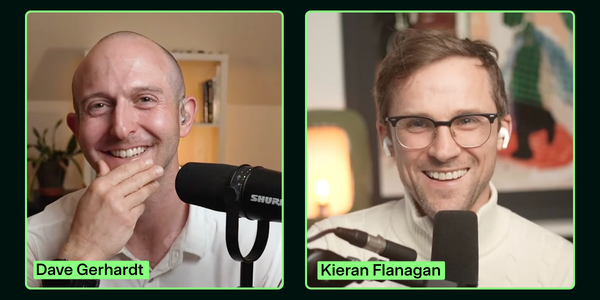
I was talking to Kieran Flanagan about this (he’s SVP of Marketing at HubSpot and a huge AI marketing nerd in a good way) and said the same thing: “I have never been so happy to be a marketer.”
He’s one of the sharpest people I know when it comes to where marketing is actually going so this felt like a huge win for my confirmation bias. But we also talked about the flip side — because while AI is creating a ton of opportunity, it’s also reshaping what it means to be valuable as a marketer in a company today.
Here are four things from our conversation worth thinking about if you’re trying to future-proof yourself right now (and here’s a link to the conversation with Kieran if you want to listen later).
1. “Good enough” is the most dangerous place to be
Kieran’s core argument is that AI is squeezing the middle of marketing. Not the people at the top of their craft. The people who are good enough at a bunch of things but not exceptional at any one thing.
Here’s what makes this real.
95% of the B2B buyer journey will start in an LLM assistant instead of Google by 2027.
Source: Gartner
That means the entire content-to-clicks engine that most mid-market marketing teams are built around is getting restructured. The team that existed to produce a steady stream of competent blog posts, landing pages, and nurture sequences? That work could now be done by a marketer with good prompting skills and some time blocked.
Let’s be clear: this isn’t a layoff prediction. It’s a skills prediction. The marketers who were valuable because they could produce reliable B+ work across a bunch of channels are the ones who need to make a move. Because B+ is now the default output of the machine.
But I guess you could say this has always been true — there’s no place for mediocre marketing. Or as Brendan Hufford calls it “checkbox marketing.”
2. Go deep on one thing, not wide on everything
Kieran’s advice: pick a lane and make sure you are on the outer edges of that lane.
AI is the ultimate generalist. It can cover ground better than any human. What it can’t do is go deep. So the move right now is the opposite of well-rounded. Figure out the thing you’re genuinely great at and go further on it than feels comfortable. Use AI to handle everything else.
Early in my career at Drift, I almost made this mistake. I was watching everyone become the “growth marketer” in the 2010s and I thought that’s where the job security was in marketing. I needed to become the growth guy. David Cancel, our CEO, told me the opposite: you have a superpower in creativity and storytelling. Double down on that. That will create the growth (and it did). That conversation shaped my entire career. And the advice is even more true now with AI.
3. Start building your own AI toolkit
The marketers who are pulling ahead right now aren’t just using AI. They’re building systems around it that compound over time.
Kieran is a great example. He has 12 custom GPTs, each one trained on a different prompting methodology or framework. Whenever he finds something that produces strong output, he saves it so he can build on it later. He described it as a prompt swipe file, which is the perfect analogy. Marketers have always kept swipe files of great ads, emails, and landing pages. Now the swipe file is for the prompts and workflows behind your best work.
But the real unlock is using AI to get better at using AI. One of Kieran’s moves: when he’s using a tool like Genspark to build a presentation, he doesn’t prompt it directly. He goes to Claude or ChatGPT first, feeds it the technical documentation for the tool, and has the AI then craft the prompt. The output is dramatically better because the prompt is written by a model that understands the tool’s capabilities, not by a human guessing at syntax.
Most marketers open a blank chat, write a vague prompt, get a vague result, and conclude that AI isn’t that useful. The ones building real leverage are treating their AI setup the way a demand gen leader treats their tech stack: something you configure and optimize over time, not something you use out of the box. Marketing today is about being able to create a great brief, where the brief is the prompt.
4. Bet on the things AI can’t do
The marketing leaders I admire most have always been the ones who could do the job, not just manage the people doing the job. It’s fun to see when someone still has their fastball in marketing; not just that they know how to run a performance review cycle. AI is making that possible again. The manager doesn’t just have to manage.
For the last decade, the path for a great marketer was: get good at marketing, get promoted, stop doing marketing. Kieran and I both lived this. I told him that when I had a team of 30, my whole day was performance reviews and cross-functional syncs. He said the same thing. The craft is what gives him energy, not the org chart.
AI is shrinking teams, and for the right marketer, that’s the whole point. The future CMO might run a team of 8 instead of 80 and actually touch the work. Strategy to execution in the same afternoon instead of waiting two sprints for something to ship. That’s the job most of us wanted in the first place.
Become the marketer who can think and do. Strategic judgment to know what’s worth building and the hands-on ability to build it, with AI as your leverage. The full stack marketer. That’s who companies are going to be fighting over.
— Dave
P.S. What are you doing right now to future-proof your marketing career? Hit reply and tell me. I read every response.
Also, re: “that’s the job most of us wanted in the first place” — maybe not true for everyone. Some are natural born managers, but you’d still want to ship something no?
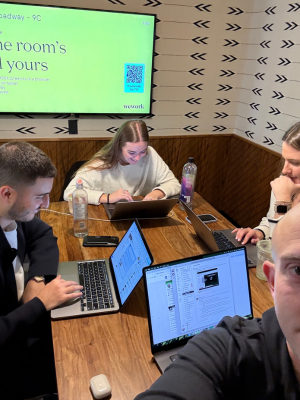
Hanging with the Exit Five team in NYC; wish we did this more often #remotelife