5 B2B ad campaigns that actually worked
B2B advertising is full of theory and short on proof. Most marketers are making budget decisions based on vibes, benchmarks from industries that don’t match theirs, or case studies that are too vague to be useful. What we actually need are real B2B advertising examples — with real budgets, real results, and real numbers attached.
That’s what this post is. 11 B2B ad campaigns that actually worked, shared by the marketers who ran them. Not theoretical frameworks. Not “we saw a lift.” Actual campaigns, actual spend, actual pipeline and revenue outcomes.
If you’re trying to figure out where to put your next dollar in paid — LinkedIn, CTV, direct mail, event sponsorships, or somewhere else entirely — this is the most honest look at what’s working right now in B2B advertising.
11 B2B Advertising Examples That Actually Worked
Five B2B Ad Campaigns That Actually Worked (With Real Numbers)
Nothing gets people paying attention more than examples.
I’ve been doing this for fifteen years and the one thing I know for certain is that marketers can never get enough real examples. Not frameworks. Not theory. Just: what did you actually do, how much did you spend, and what happened?
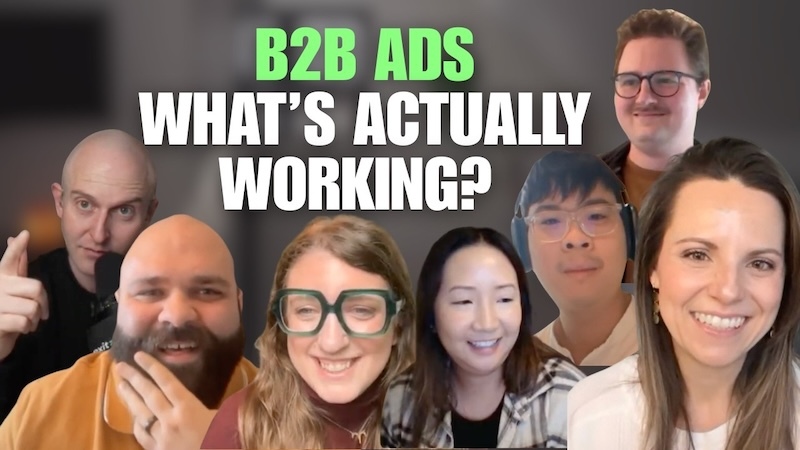
Today I’m sharing examples from five demand gen marketers on our recent “B2B Ad Campaigns That Actually Worked” call. Here’s the video if you want to watch each example.
1. Thought Leader Ads: $8K Into $700K in Pipeline
Cindy Dubon, Director of Growth Marketing at Goldcast, ran an influencer-powered product launch on LinkedIn. She found four people who genuinely used the product, paid them $500 to $1,000 each to post about it in their own words, and then ran those posts as thought leader ads against a tight list of target accounts. No scripted copy. No brand account posts. Real people talking about how they actually use the product, promoted to accounts that sales was already working. Total ad spend: $8,000. Pipeline generated: $700,000. Closed-won revenue: $400,000.
2. Surround Sound: CTV, YouTube, LinkedIn +41% Pipeline
Kelly Arndt, Sr. Demand Gen Manager at Vector, built a surround sound campaign using one hyper-targeted ICP audience across connected TV, YouTube, brand solution ads, and thought leader ads on LinkedIn. Same audience everywhere. Different formats, different messaging, all running simultaneously. She spent $35K on four videos and kept the CTV budget between $30 and $60 per day. Early results: 34% increase in net new traffic, 22% increase in demo requests, and 41% more pipeline month over month. Total quarterly budget: $60K.
3. Direct Mail to VCs: $11.5K Spent, $324K in Revenue
Jeremy Chung, founder of Ads by Jer, wanted to book meetings with venture capital partners. He used Claude to audit the ad accounts of their portfolio companies, then sent 1,200 personalized postcards at $1.50 each with a QR code linking to a Loom video walkthrough of the audit. Anyone who scanned got a $35 custom booklet shipped to their office with the full teardown. He layered in email sequences and about $3K in LinkedIn retargeting on top. Result: 22 meetings booked, roughly $324K in revenue, at about $500 per meeting.
4. Tradeshow: No Booth and 2,000% ROI
Tess Pfeifle, Associate Director of Marketing at AirVet, went to a conference without a booth. Her move: sponsor the pre-event happy hour to get the attendee list, upload it to LinkedIn, and run two ad creatives. One said “Let’s talk at the conference.” The other said “Win a dog pen.” The dog pen ad won. Intent data showed 65% of conference attendees visited their website before the event, nearly double typical booth traffic. Total spend including sponsorship: $11K. Results: 11 on-site meetings, 5 post-event meetings, 3 open deals, and over 2,000% ROI.
5. Facebook and Google Display vs. LinkedIn
Richard Meyer, Director of GTM and Growth at GoHappy, had 90% of his ad spend on LinkedIn when CPMs jumped 91% in one quarter, audience penetration dropped to 23%, and meeting booking rates fell 36%. He moved just 20% of his budget to Facebook and Google Display using signal-based targeting, building an intent flywheel where first-party signals feed into Clay, sync back to HubSpot, and push audiences into ad channels. The results: 2x the impressions of the entire previous quarter, CPMs dropped 75%, pipeline hit 3.5x the monthly average, and from paid channels specifically, 5.2x.
6. The “CFO for a Day” Livestream Stunt: 112M+ Views
Ramp put actor Brian Baumgartner (Kevin from The Office) in a glass box in the middle of NYC, cast him as a “CFO” manually processing expense reports for a full day, and livestreamed it with a running counter comparing his manual pace to Ramp’s automated one. The stunt generated 112M+ views across platforms — a visual, absurd demonstration of a boring pain point (manual expense reports) traveled further than any explainer video could. (source, source)
7. Enriched Audiences on LinkedIn and Meta: $250 to $25 Cost-Per-Lead
Clay enriched its own prospect and customer lists with verified professional contact data before uploading them as custom audiences, raising Meta’s audience match rate from roughly 30% to over 70% — the platforms could finally tell who these people actually were. LinkedIn cost-per-lead dropped from $250 to $25 (a 10x improvement) and Meta hit $10 CPL, generating 200 leads in 24 hours. The lift came from audience data quality, not creative. (source, source)
8. A Super Bowl Ad That Only Ran in Three Cities
Gong bought Super Bowl airtime only in Seattle, San Francisco, and New York — the markets where its buyers actually lived — instead of a national buy. The ad featured a “VP of Sales” character shrinking and growing to dramatize pipeline recovery, closing with a literal gong strike, targeting buyers on their couch instead of at their desk. Within five working days, over 400 people mentioned the Super Bowl ad on sales calls, and Gong broke its own record for inbound opportunities created and accepted in a single week. (source, source)
9. Account-Based Display to Named Accounts: Quoted Business in 3 Weeks
Instead of broad, untraceable display spend, ZoomInfo built a target account list for customer LINAK, identified the specific buying contacts inside each account, and ran programmatic display ads aimed only at those people — including staying visible against competitors already in the deal. The campaign generated quoted business within three weeks, in a category where marketing results normally take months to show up. (source)
10. AI-Generated Ad Copy for ABM: 54% Higher CTR
Snowflake’s ABM team used its own Cortex AI, tuned with brand guidelines, to generate ad copy variants at a scale a human creative team couldn’t match, then tested that copy directly against original human-written versions. The AI-generated variants produced a 54% lift in click-through rate over the original copy — proof that AI creative can beat human-written ads when it’s grounded in real brand and audience data, not just speed. (source)
11. Direct Mail Gifting via Sendoso: 23x Pipeline Lift
Chili Piper’s sales team sent prospects a custom box of branded hot sauce with a handwritten note (“Spice up the office!”), sequenced behind email cadences that warmed the prospect up before the physical gift arrived — so the mail landed as a memorable follow-up, not a cold surprise. The campaign reached 4x more prospects than Chili Piper’s prior outreach and drove a 23x increase in pipeline influenced by the program. (source, source)
Everyone we featured above was super helpful during this session, and if you have a question about something they covered here, I bet they might be able to answer a question or two, so I linked everyone’s LinkedIn profiles above. Ex: if you have a question about CTV or Thought Leader ads.
What’s the best ad campaign or marketing play you’ve run recently?
Hit reply and tell me about it.
We’re always looking for real examples to feature on the podcast and in the newsletter.
– Dave
What These B2B Ad Campaigns Have in Common
After collecting hundreds of examples from Exit Five members, a few patterns show up in every B2B ad campaign that actually works:
1. They use real people, not brand accounts
Four of the five examples above involve content from actual humans — whether it’s thought leader ads running from real LinkedIn profiles, personalized postcards with custom video, or event sponsorships built around genuine relationship-building. B2B buyers are skeptical of brand voice. Real people break through.
2. They have tight targeting, not broad reach
Every one of these campaigns was built on a specific audience: named accounts sales was already working, a list of venture capital partners, a conference attendee list, or signal-based first-party data from existing customers. None of them tried to “build awareness” broadly. They found a tight list and surrounded it.
3. They connected spend to pipeline, not impressions
The marketers in these examples could tell you exactly what happened after the ads ran — how much pipeline was generated, how many meetings were booked, and what closed. If your B2B advertising strategy can’t connect to those outcomes, you’re probably optimizing for the wrong thing.
4. They didn’t rely on LinkedIn alone
Even in the examples that used LinkedIn heavily, the most effective campaigns layered in other channels: CTV, direct mail, email, Google Display, event activations. One channel is rarely enough. The marketers who saw the best results were running coordinated plays across multiple touchpoints to the same audience.
5. They were willing to test unconventional formats
Dog pen ads at conferences. Postcards to VCs. Surround sound campaigns with $60/day CTV budgets. The best B2B advertising examples we see aren’t playing it safe — they’re running experiments in formats most B2B marketers are ignoring.
B2B Ad Campaign Results at a Glance
| Marketer | Channel / Format | Spend | Result |
|---|---|---|---|
| Cindy Dubon, Goldcast | LinkedIn Thought Leader Ads | $8,000 | $700K pipeline, $400K closed-won |
| Kelly Arndt, Vector | CTV + YouTube + LinkedIn (surround sound) | $60K/quarter | +41% pipeline MoM, +22% demo requests |
| Jeremy Chung, Ads by Jer | Direct mail + LinkedIn retargeting | ~$11.5K | 22 meetings, $324K revenue |
| Tess Pfeifle, AirVet | Event sponsorship + LinkedIn ads | $11K | 16 meetings, 3 open deals, 2,000%+ ROI |
| Richard Meyer, GoHappy | Facebook + Google Display (signal-based) | 20% budget shift | 2x impressions, 75% lower CPMs, 5.2x pipeline |
| Ramp | Livestream stunt (out-of-home + social) | Not disclosed | 112M+ views across platforms |
| Clay | Enriched audiences (LinkedIn + Meta) | Not disclosed | LinkedIn CPL $250→$25, 200 leads/24hrs |
| Gong | Regional Super Bowl TV (3 cities) | Not disclosed | 400+ sales-call mentions in 5 days, record inbound week |
| ZoomInfo (for LINAK) | Account-based programmatic display | Not disclosed | Quoted business within 3 weeks |
| Snowflake | AI-generated ad copy (ABM) | Not disclosed | +54% CTR vs. human-written copy |
| Chili Piper | Direct mail gifting (Sendoso) | Not disclosed | 4x reach, 23x pipeline lift |
How to Apply These B2B Advertising Examples to Your Own Strategy
The common mistake B2B marketers make with advertising is treating it as a separate function from the rest of go-to-market. The campaigns above worked because they were tightly integrated with sales (Cindy’s thought leader ads against named accounts), with product (Richard’s first-party signal flywheel), and with events (Tess’s conference activation).
Before you try to replicate any of these, ask yourself:
- Do I have a tight enough audience list, or am I targeting too broadly?
- Can I track this campaign all the way to pipeline and revenue — not just clicks and impressions?
- Am I using real people (customers, executives, practitioners) or brand accounts?
- Am I reaching the same audience across multiple channels, or putting all my spend in one place?
- What format are my target buyers not seeing from competitors right now?
The best B2B ad campaigns aren’t the ones with the biggest budgets. They’re the ones with the clearest thinking about who they’re reaching, what they want them to do, and how they’ll know if it worked.
Want more examples like these? We run a monthly “What’s Working” session in the Exit Five community where B2B marketers share real campaigns, real results, and real tactics. Join the community to get access.
Related from Exit Five: ABM KPIs & Metrics: The Complete Guide
Frequently Asked Questions
What makes a B2B ad campaign successful?
The most successful B2B ad campaigns share a specific mechanism, not just budget size. Winners in this list used hyper-narrow account targeting (ZoomInfo/LINAK, Clay), a physical or novel format that broke through the noise (Rampu2019s livestream stunt, Gongu2019s regional Super Bowl ad), or layered multiple touchpoints so the same buyer saw the message repeatedly (Vectoru2019s CTV/YouTube/LinkedIn combo, AirVetu2019s event plus retargeting).
What channels work best for B2B advertising?
No single channel wins outright. LinkedIn remains a strong default for account-based targeting (Goldcast, Clay), but direct mail (Ads by Jer, Chili Piper), Connected TV (Vector), programmatic display (ZoomInfo), and even national TV (Gong) all produced strong ROI when paired with tight targeting and a follow-up sequence.
How much budget do you need for a B2B ad campaign to work?
Not much, based on these examples. Goldcast spent $8,000 and generated $700,000 in pipeline; AirVet spent $11,000 for 16 meetings and 2,000%+ ROI; Ads by Jer spent $11,500 and generated $324,000 in revenue. Small, tightly targeted budgets consistently outperformed size alone.
Does direct mail still work for B2B marketing?
Yes, when itu2019s personalized and sequenced with digital follow-up. Ads by Jer used AI-generated video audits sent via postcard to VC firms and generated $324,000 in revenue from $11.5K spent. Chili Piperu2019s branded direct-mail gifting campaign drove a 23x increase in influenced pipeline by warming prospects with email first.
What is account-based advertising (ABM ads)?
Account-based advertising targets a specific, named list of buying accounts and contacts rather than a broad audience. ZoomInfou2019s campaign for LINAK built target account lists and reached the specific buying contacts inside each one, generating quoted business within three weeks u2014 much faster than typical broad-audience display advertising.
Can AI-generated ad creative outperform human-written ads?
In at least one documented case, yes. Snowflake used its Cortex AI, tuned on brand guidelines, to generate ad copy variants for its ABM program and saw a 54% lift in click-through rate over the original human-written copy u2014 though the gain came from grounding the AI in real brand and audience data, not from AI alone.