5-Step Framework For Clear B2B Positioning
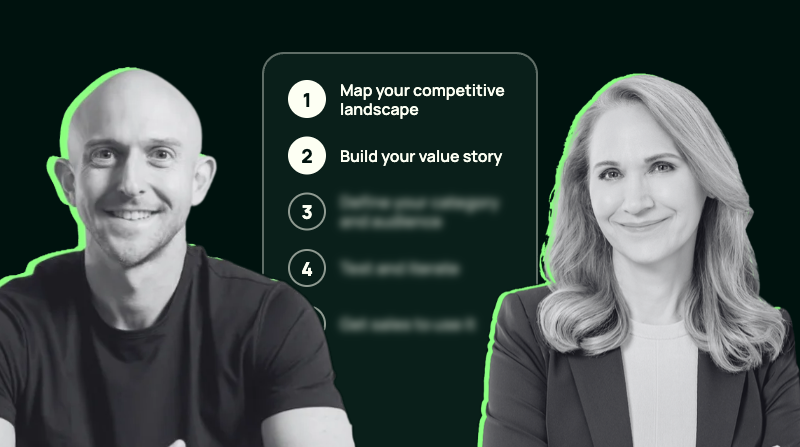
April Dunford is one of the foremost positioning experts in the world. She’s built her framework across 200+ client engagements, and her book Obviously Awesome is part of the B2B canon. It’s timeless marketing advice that’s worth revisiting time and time again.
The problem she sees over and over goes like this. Marketing does the positioning work, gets the sign-off, and hands it to sales. Then the first sales call turns into a product walkthrough (here’s how you log in, here are the seven dropdown menus, let me click on every single one).
Clients tell her: “Marketing loves it. Product loves it. Sales refuses to use it.” Nobody answers the one question the customer showed up with: why they should pick you over the other options on their shortlist. Here are her five steps to clear positioning that sales will use.
Step 1: Map Your Competitors So You Know Who You’re Up Against
Start with who you actually compete against. If you ask product, you’ll get a list 200 companies long (“I Asked Claude?”). Ask sales, and they’ll say “Oracle.” For positioning, the only competitors that matter are the ones that show up on a customer’s shortlist. If a company never makes the shortlist, your customers don’t know about it, so there’s no reason to position against it. As April puts it, there’s no need to position against a ghost.
I lived this at Drift. Product could name something like 20 competitors, but sales would tell you it was one: Intercom. About 80% of our deals came down to Drift or Intercom. So instead of building 15 product marketing assets for every possible competitor, the move was to nail the Intercom story and lead with it on the website.
There’s one competitor sales almost never counts: the status quo, meaning whatever the customer is doing today instead of buying anything. Those deals get logged as “lost to no decision,” but the status quo still won. Matthew Dixon’s research in The Jolt Effect found that 40-60% of B2B purchase processes end in no decision. So your positioning has to beat two things: the companies on the shortlist, and the option to do nothing at all.
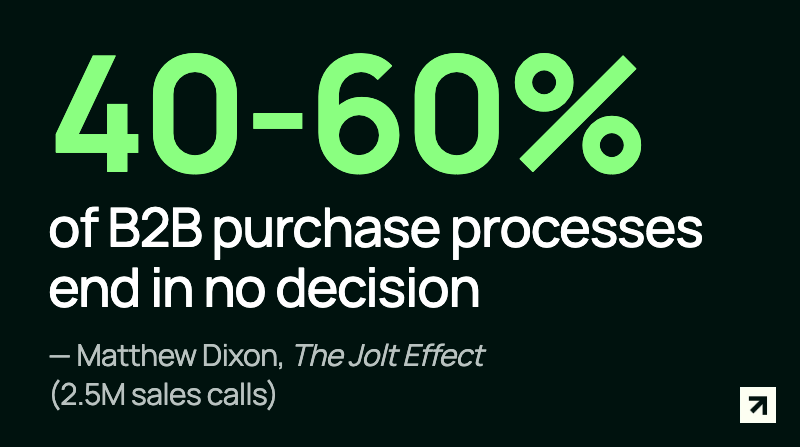
April Dunford points to Matthew Dixon’s research in The Jolt Effect (2.5 million sales calls) as proof that most lost deals don’t go to a competitor. They stall because the buyer can’t decide.
Step 2: Build Your Value Story So Buyers Know Why To Pick You
Next, list what you have that the competitors on the shortlist don’t, and turn each one into a reason to buy. If customers are already choosing you, the reason is there somewhere. Sometimes it’s not even a feature. You might be the only one offering professional services, or your pricing model might fit how the customer buys better.
At IBM, April sold a database that was basically identical to Oracle’s. The only real difference was a few small features that made IBM’s database easier to connect with everything else. On a feature checklist, nobody would’ve noticed. So IBM wrapped those features in one big idea, “openness equals innovation,” and pitched it to the biggest companies in the world, who hated being locked into one vendor. IBM won those deals. The features were small, but the story around them made the value big.
Step 3: Nail Your Audience And Category, And The Right Buyers Will Find You
Once you know your value, figure out who cares about it most. April’s CRM company started with “we’re like the market leader, but cheaper,” and nobody bought. So they narrowed to CRM for investment banks, a market where their product had a real edge and they knew they could beat the big player. That’s where they started winning.
Category sits here on purpose. Its only job is to point a buyer toward your value, so it’s much easier to start in a category buyers already know. Only about 1 in 10 of April’s clients create a new one, and being first doesn’t guarantee a win. Ask Jeeves created search before Google wiped it out, and Research In Motion created the smartphone before Apple showed up.
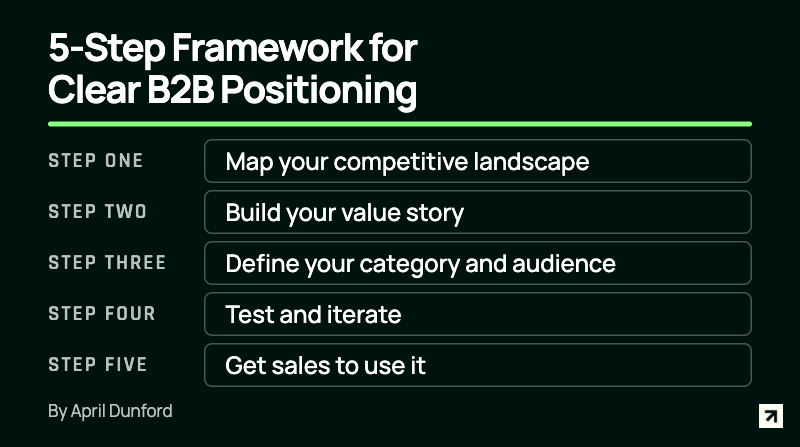
Timeless marketing lessons: April Dunford’s five step framework for clear B2B positioning.
Step 4: Test And Iterate, Because Positioning Won’t Last Forever
It’s tempting to treat positioning like it’s set in stone, but your product, competitors, and market are always changing. Just think: Salesforce isn’t pitching anything close to the story it started with. So focus on what you can sell today, and build positioning that wins deals for the next six months. Then plan the next version in parallel, and revisit it when a new competitor starts showing up on shortlists and winning deals.
Back to April’s CRM company example. A small CRM company’s investors thought “CRM for investment banks” was too small, so the team mapped out the path. They’d dominate investment banks first, then expand to retail banks, then financial services, and eventually all of enterprise CRM. If they had pitched enterprise CRM on day one, they’d have gone head-to-head with the market leader, a company with more money, more features, and more customers, and they would have lost. Starting with investment banks, where their product had a real edge, let them win first and grow from there.
Step 5: Build It With Sales, And They’ll Use It
Great positioning doesn’t do much if it never makes it into a sales call. So build it with sales, product, and the CEO in the room instead of handing it over finished. Without a process, it turns into a battle of opinions, and marketing rarely wins those. Then bring it into the first sales call.
Before the demo, walk the buyer through how you see their market, the other options they could pick, and what the ideal solution looks like. For example, a customer service platform might open by getting the buyer to agree that customer service can drive growth, not just cost money, and only then show the product.
That’s the goal of the whole framework: nobody leaves the first call without knowing exactly why they should pick you over everyone else on their shortlist.
Strong Positioning Never Goes Out Of Style
None of the fancy new tools, playbooks, or channels out there work if you can’t explain why someone should pick you over everyone else on their shortlist. Get your positioning right first, and every tactic after it gets a lot easier. Check out our top performing episode ever, wherever you get your podcasts: [Best of B2B] April Dunford – Positioning, Differentiation, Lessons from 200+ Sales Pitches, and How To Do It Right.