How to be the CMO everyone loves
10 Things That Stuck With Me From Dave Kellogg’s Talk on Being the CMO Everyone Wants to Work With
I’ve been sitting on this newsletter for a few weeks now.
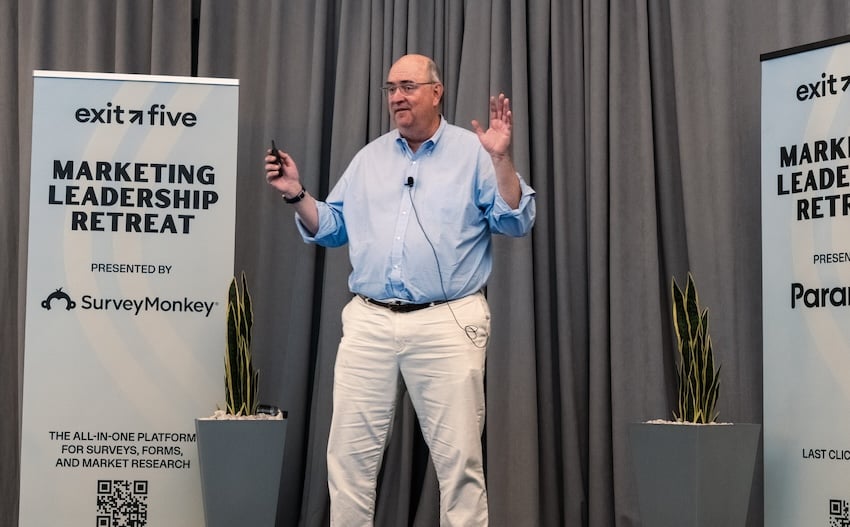
In March, we hosted our first annual marketing leadership retreat for Exit Five in Arizona, and I wanted to find the right speaker to set it off – someone who wasn’t going to talk about AI, but more broadly the role of CMO.
Dave Kellogg has been on all sides of the table: 10 years as a CMO. Then 10 years as a CEO. 10 different boards. He ran marketing at Business Objects and took them from $30M to a billion. He’s been a CEO twice.
I’ve been following his “Kellblog” for the last decade and referred to it often when I was running marketing and needed to sound a lot smarter than I actually was in front of my CEO and the board (don’t tell anyone).
But his writing was also like some type of therapy for marketers. His thinking helped me become more of a “dispassionate analyst” when it came to talking about marketing performance at the company, instead of always getting defensive as the hot-headed VP of Marketing who was never wrong.
I had him on the Exit Five podcast years ago and it’s still one of the most downloaded episodes ever. And I found out recently he actually goes to a bunch of our webinars too. He’s still a marketing nerd just like us.
His talk to kick off our Marketing Leadership Retreat was called “How to Be the CMO Everyone Wants to Work With.”
Here are the 10 top lessons below, and here’s the full audio/video from his talk on my podcast, even if you weren’t with us in Arizona. I got you.
1. Always bring data to the party.
Every time a salesperson or CEO says something that sounds like a fact, write it down. “Nobody’s heard of us.” “We win more deals than anyone in the space.” “We never lose to Competitor X.” Those are assertions, not facts. Your job is to go get the data, come back, and let the numbers speak. It stops you from being defensive and it stops bad decisions from getting made on vibes. Bring the data.
2. Start with the audience, never the slide sorter.
Dave chirped: “The road to hell begins in slide sorter view.” What he means: if you’re building a board deck and you open say, an internal QBR deck and start plucking slides from it for the board meeting, you’re already dead. Start with a blank page and one question: who am I talking to and what do they want to hear? Reuse is not a virtue. A slide built for analysts will get you eaten alive in front of customers; the internal marketing deck will get shredded if used for the board.
3. Be an expert. Position yourself as a “marketing professional.”
Nobody gets arrested for impersonating a marketer. There are a lot of dabblers in this function. Your job is to not be one of them and to not be seen as one. This means: study the craft. Quote the research. Talk about what other companies are doing. Remind the room that you take this seriously. And this is what I have loved about building Exit Five; I know so many of you reading this email right now treat marketing this way. It’s a profession! Not arts and crafts (tell the sales guy that please).
4. How to combat the asks from sales: diagnose before you prescribe.
If you walked into a doctor’s office and said “I need 500 milligrams of amoxicillin,” they’d stop you and ask about your symptoms. But when sales walks in and says “we need a VIP booth at the Yankees game,” we say “two-fifty or five hundred?” Marketing exists to make sales easier. That doesn’t mean saying yes to every request. It means asking what problem we’re actually solving first.
5. Build a first ring relationship with your CRO.
When your sales counterpart calls you, do you say ugh and ignore the call, or do you actually want to pick up? Dave coached us that the bar isn’t sales and marketing alignment. Alignment isn’t enough. The bar is “Woodstein” from All the President’s Men (Woodward and Bernstein jammed together). You and your CRO are one unit. You answer each other’s calls on the first ring. You speak multiple times a day. Your CRO will win arguments with the CEO and CFO that you won’t win alone. That partnership is the single biggest lever you have.
6. You must lead the horse to water.
Marketers love mass communication. Campaigns. Messaging. Air war. That’s not how you actually change minds inside your company. If you want to change the mind of your CEO or a board member, you need to be a canvasser, not an advertiser. One conversation. Understand their view. Find out why they hold it. The tools that work on prospects don’t work in the C-suite. This is like marketing to a completely different audience than customers. Understand that first.
7. Please, please, please worry about the whole funnel.
Peter Drucker said in 1954: “Marketing is the whole business seen from the point of view of the customer.” Which is the perfect way of saying: you can’t just focus on the top of the funnel! If close rates are the issue, that’s your issue too. If churn is the issue, that’s your issue too. Everything is too important to be ignored by marketing. You just have to learn how to weigh in respectfully, with data, without sounding like you’re pointing fingers.
8. The CMO must be a dispassionate analyst.
“Congratulations, we made plan in this one segment, but overall we lost market share.” That’s how Kellogg flagged a problem he had at Business Objects back in the day without starting a fight. You don’t make the news, you just report it. The issue is on the table. No one’s being accused. Now the room can talk about what to do. Present the facts and let a discussion happen (again back to not being defensive).
9. Answer the f*cking question.
You must be able to answer questions directly and specifically in marketing. If someone asks what churn was last quarter, the answer is “12% on a GAAP basis” (on an example). It is not a three-minute story about cohorts and methodology and well, we measure it this way because of this thing and… Answer the question. Leave a thread if there’s more to say. The more senior the audience, the more they hate being talked at when they asked for a number.
Note: please go and listen to the talk and you will get the entire context of this one. It’s great and super useful for any type of executive, board, or internal communications as a CMO.
10. You’re not running marketing, you’re running for office.
This is how you have to think about the job: your customer is sales. Your boss is the CEO. Your boss’s boss is the board. So you need to be out there. Not just dropping @ here mentions in Slack and wondering why people don’t get what marketing is doing. You need town halls with the sales team. One-on-ones with the best reps. Proactive comms about what marketing is doing and why. If you don’t market marketing, the villagers will come for you with torches. Waiting to be understood is not a strategy.
There’s a lot more in the full talk, including his framework for CMO failure archetypes (like the Tasmanian Devil, the Scapegoat, the Second-Guesser) that had the room nodding and laughing at the same time. If you’re in a marketing leadership seat, or trying to get into one, it’s worth the full listen.
– Dave
P.S. My only PS for today is to just go listen to the full talk; no matter what I write in this newsletter is not going to do it justice. His delivery is great. Go listen, take notes, and then reply back to me and let me know if I over-hyped this or if it was helpful 🙂