Why Every B2B Marketing Leader Should Master Working With Finance

Here’s something we don’t talk about enough: being good at marketing isn’t just what shows up on LinkedIn. There’s a separate skillset – internal marketing – and a huge part of that is how you partner with Finance. Apparently, Patrick is good at it. He’s the SVP of Global Marketing at BlueVoyant, a $175M revenue, 600-person managed detection and response company, meaning they run security operations for other companies, monitoring threats so those companies don’t have to.
Patrick has spent over a decade in cybersecurity marketing – his third company in the space. Before cyber, he was employee #100 at HubSpot (where we met), standing up the company’s first partner and field marketing teams. At BlueVoyant, he started ABM for field marketing and developed relationships with key tech partners. At his last stop, Recorded Future, he ran a $10M growth budget.
None of this is possible if Finance doesn’t trust you. Something I’ve noticed (no shame – tell me if you relate): marketers get defensive the second finance asks a question about spend. Here are a few tactics Patrick uses to skip that part. Need advice for working with Finance as a Marketer? Full episode here.)
Tip 1: Divide Your Budget Into Small Buckets. (Don’t Try to Defend the Whole Number at Once.)
Slice and dice your budget in as many ways as possible.
- First, the easy cut is by category: digital, events, your key buckets.
- Then region: In Europe, you get X amount for events.
- Then, within categories, like Digital:
- Ads
- content syndication
- Sponsorships, etc.
Many marketers miss this step. They explain their budget as one big number instead of laying out the high-level structure first. When Finance knows that each bucket behaves differently, you’re not defending every single event or ad, you’re just making sure finance understands the type of spend each bucket represents.
In practice: Regional reps at BlueVoyant run what Patrick calls “backyard events” – a rep in Kansas City might spend $10,000 on a local analyst-style event. Because that spend lives in its own bucket, it doesn’t get lumped in with, and defended against, the rest of the budget every time.
Tip 2: Forget Cost-Per-Lead. Use Cost-Per-Opportunity Instead.
If you’ve ever wondered how to actually come up with a marketing budget number instead of guessing, here’s a benchmark worth stealing.
In true Dave Kellogg fashion, Patrick avoids discussing cost-per-lead entirely. Instead, he takes marketing spend for the year and divides it by the total number of net-new opportunities the company created – not just what Marketing sourced.
Cost Per Opportunity = Total Spend ÷ Net-New Opportunities
Why the total and not just Marketing’s slice? Because Patrick thinks marketing should lift every channel, including sales’ own sourced pipeline. If you’re doing good marketing, sales should have an easier time closing deals on their own too, simply because more people have heard of you. So instead of fighting the marketing-vs-sales attribution argument, he just takes responsibility for the whole number.
Brace yourself the first time you calculate it – it’ll be high. This means you’ve found your baseline – and that’s something you can negotiate down. More on that next.

Tip 3: Show Your Math Before Finance Asks, So You’re in Planning Mode – Not on Defense.
Once you have your baseline cost-per-opportunity, turn it into a target. Say it’s currently $5,000 – tell Finance you’re driving it down to $2,500 to hit your contribution goal for the year. That’s the number you’re now accountable for.
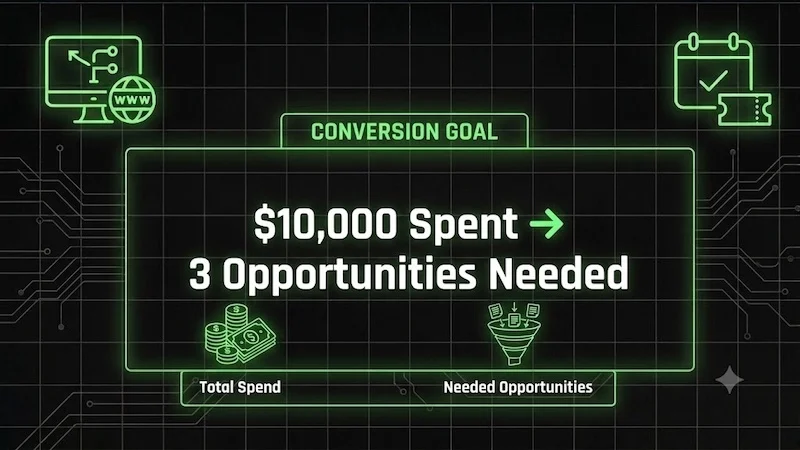
Then get specific. Apply that same math to a single event before you spend a dollar: spend $10,000, and you need X opportunities back to justify the spend.
$10,000 spent → X opportunities needed
This is how you defuse sticker shock on a big-ticket item. Instead of walking into a budget conversation saying “we want to spend $100,000 on a sponsorship,” you walk in with the math already done – here’s the number, here’s what it needs to produce. A scary number turns into a straightforward ask.
The catch: You have to land it. Some events will over-perform, some will under-perform – that’s normal. But once Finance has seen your methodology enough times, a miss on one event doesn’t blow up their trust in the number – and you.
Tip 4: Meet Regularly With Finance to Build Trust.
At Recorded Future, Patrick ran a $10M growth budget with a dedicated finance partner he met with every single week – not once a quarter, not at a big annual review. Every week.
No fancy dashboards, just a plain spreadsheet: what’s pending approval, what’s already approved, and what’s left – broken out person by person on the team. No guesswork. If someone on the team was running under or over budget, it showed up immediately, and Patrick could go talk to that person’s manager about why – before it became a bigger problem that Finance had to flag first.
Do this weekly, and the buckets, the cost-per-opportunity math, the budget asks – all gets easier. Save it for one big quarterly sync, and you’re stuck defending a quarter’s worth of decisions all at once.
I also talked with Patrick about why he killed the annual marketing plan, turning field marketing into an account-based motion instead of an events motion, and how BlueVoyant markets to its tech partners almost as aggressively as it markets to prospects. Check out our full conversation here.