B2B Marketing Plan Template: 8 Steps to Get It Approved

A B2B marketing plan gets approved when it starts from company goals, not marketing activity. Agree on finance’s guardrails first, show how marketing contributes to revenue, choose a few themes for the year, split the budget so leadership can see the tradeoffs, and present it in financial terms. Here are the 8 steps, plus a one-page template.
The annual planning process is one of those parts of the B2B marketing job nobody teaches you in school. So if you’re overwhelmed right now, take a breath. This guide is based on an Exit Five live session with Rowan Tonkin, CMO at Planful, who walked through how to structure, present and win approval for a marketing plan. We’ve added what other marketing leaders in the Exit Five community do when the plan meets the exec team and the board.
B2B marketing plan template (one page)
Before the steps, here’s where you’re headed. A plan leadership will approve fits on one page. Everything else goes in the appendix.
| Section | What to include | Step |
|---|---|---|
| Guardrails | The ratios finance watches (for example marketing spend as a percentage of revenue, CAC) and the metrics the CFO cares about most | 1 |
| Company goals | The company’s top goals for the year, agreed with sales, product and finance | 3 |
| Marketing’s contribution | The pipeline and revenue marketing will deliver toward those goals | 2, 3 |
| Themes for the year | A few focus areas you’ll keep working on all year, not a fixed list of tactics | 3 |
| Budget split | Strategic and productive (55–75%), non-strategic fixed costs, experimental (10–20%) | 4, 6 |
| Executive metrics | Pipeline, revenue and ROI, kept separate from the operational metrics your team uses | 2 |
| Risks and scenarios | High-risk, high-dependency bets and what changes if conditions shift | 5, 7 |
| The ask | What you need approved, in incremental revenue or pipeline terms | 7, 8 |
1. Know your guardrails
If you know your constraints up front, you can build a realistic plan. Before you do anything else, sit down with your finance team and learn what they look at:
- Key ratios: your company’s benchmarks, like marketing spend as a percentage of revenue or customer acquisition cost (CAC). Understand what they value and what “good” looks like to them.
- Financial priorities: which metrics, such as pipeline ROI, the CFO cares about most.
Tip: think like an investor. Frame marketing as an investment, not just an expense. The numbers side of this, from cost per opportunity to splitting spend into buckets finance can follow, is covered in our guide to B2B marketing budget planning.
2. Define the metrics that matter
Every B2B marketer has been told to be more data-driven. But metrics don’t all carry the same weight. Know the difference between:
- Internal metrics: operational numbers, like conversion rates, that your team uses to optimize.
- Executive metrics: financial and commercial numbers, like pipeline, revenue and ROI, for leadership conversations.
Tip: don’t lead with vanity metrics like impressions, open rates or clicks unless they’re clearly tied to business outcomes.
3. Show how marketing contributes to company goals
The number one cause of failed plans is lack of alignment. Get in a room with sales, product and finance early to agree on shared company goals. If goals aren’t defined yet, be proactive: start the conversation and propose marketing’s contribution.
As Rowan put it: “If your marketing goals aren’t tied to company goals, leadership won’t care.”
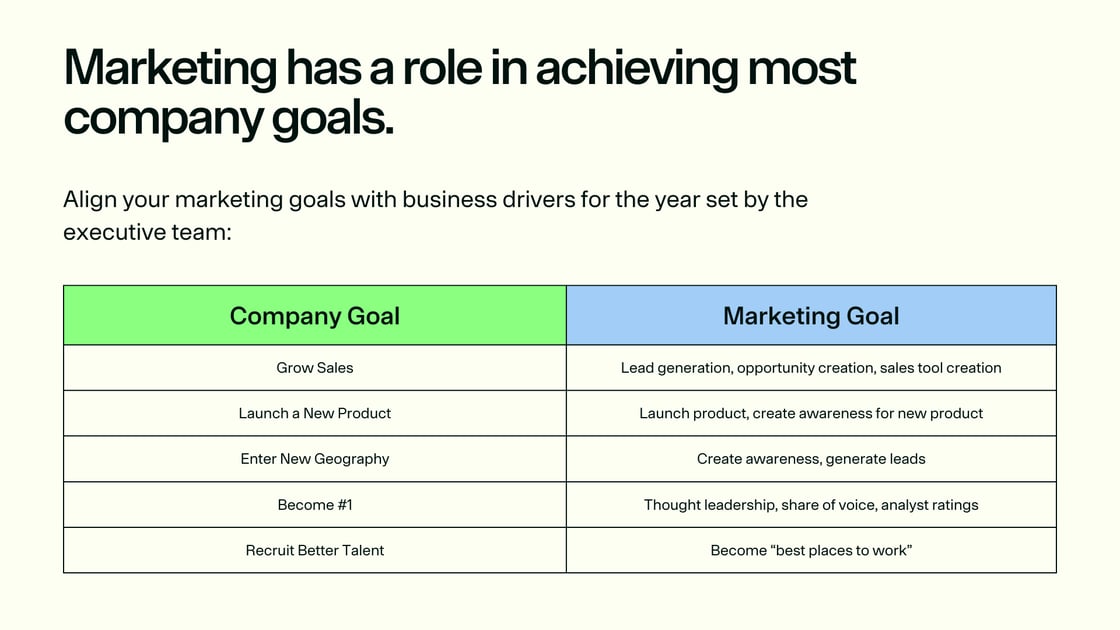
Then decide how specific to get. Patrick Shea, SVP of Global Marketing at BlueVoyant, told us on the podcast that the more specific you try to be about the year ahead, the more it blows up, because you don’t know about the product launch coming next quarter. He did a full annual plan when he joined BlueVoyant to show the exec team how he thinks, but he runs the team on two-week sprints against a few themes he’ll keep working on all year. One line in his annual plan is simply “act bigger than we are,” and almost any good idea can fit under it.
4. Choose your annual marketing planning process
There are two main ways to build a plan:
- Top-down: leadership assigns high-level budgets to each function.
- Bottom-up: teams submit detailed requests, and leadership adjusts them.
Tip: Rowan recommends a hybrid. Set top-down budget ranges, and let teams build their plans within those constraints.
5. Be prepared to make tradeoffs
Planning is a game of prioritization:
- Risk analysis: flag high-risk, high-dependency initiatives early.
- Scenario planning: show what shifts if conditions change, for example if pipeline efficiency drops.
- Iterate: update the plan based on leadership’s feedback.
Tip: frame experiments, like brand campaigns, as opportunities with clear outcomes, showing both the upside and the fallback plan.
6. Split your budget into three buckets
Break your spend into three categories:
- Strategic and productive (55–75%): programs tied directly to revenue goals.
- Non-strategic: fixed costs like legal fees and basic tools.
- Experimental (10–20%): flex money for testing new ideas.
Tip: show leadership how each allocation maps to company goals, and leave room for experiments. For how to size the number and defend it with finance, see the budget guide linked in step 1.
7. Communicate like a leader
Present the plan in terms executives value:
- Simplify: swap marketing jargon for financial terms. Instead of “We’ll increase MQLs by 30%,” say “This will generate $450K in incremental revenue.”
- Own the risks: acknowledge where you’re uncertain and how you’ll reduce that risk.
Rowan’s golden rule: “Tell the truth. Marketing leaders build credibility by being upfront.”
If the plan goes to the board, keep it shorter still. When a member of the Exit Five community was asked to share their marketing plan with the board for the first time, the advice from other members was to cover five things: what you’ll achieve, how you’ll get there, what it means for the business, why you’re doing it this way, and what failsafes are in place if it doesn’t work. Lead with revenue, then back into tactics, and put the “just in case they ask” slides in an appendix. More in preparing for board meetings as a marketing leader, or watch Rowan’s live session on how to build a marketing plan and get it approved.
8. Get buy-in
Approval isn’t about flashy slides. It’s about alignment:
- Reinforce goals: show how your plan supports the company’s top priorities.
- Show value: highlight outcomes, like incremental revenue or pipeline, over activities.
Tip: lead with education. Help leadership understand why your plan sets the business up to succeed.
After approval: turn the plan into work
A marketing plan is more than a slide deck or a spreadsheet that proves you crunched the numbers. It’s your chance to show your vision for marketing and how your strategy moves the business forward. So don’t let it sit in a folder.
One way to make it real is a team kickoff. Nadia Milami, a marketing VP at WellnessLiving, shared her offsite agenda in the Exit Five community. It ends with the team deciding which ideas go into the year’s plan, using stop, continue and start, and assigning owners so the brainstorming doesn’t go to waste. You can steal the full kickoff template here.
When in doubt, go back to basics: company goals, clear metrics and proactive communication win every time. For the full conversation, listen to Rowan Tonkin on how to build your marketing plan and get it approved.
Want more like this? The Exit Five Newsletter brings you what’s working in B2B marketing right now, with real stats, examples and tools you can take straight back to your team. Join 40,000+ marketers who read it.
Frequently asked questions
What should a B2B marketing plan include?
A B2B marketing plan should fit on one page and include finance’s guardrails, the company’s goals, marketing’s pipeline and revenue contribution, a few themes for the year, a budget split (55–75% strategic, 10–20% experimental, the rest fixed costs), executive metrics, risks and scenarios, and a clear ask. Supporting detail goes in an appendix.
How do I build a marketing plan the board will approve?
To get a marketing plan approved by the board, lead with revenue, then back into tactics. Cover what you’ll achieve, how you’ll get there, what it means for the business, why you chose this approach, and what failsafes exist if it doesn’t work. Talk to the CEO first, know your numbers cold, and move backup slides to an appendix instead of cramming them into the deck.
How do you get a marketing plan approved by leadership?
Tie every marketing goal to a company goal, agreed early with sales, product and finance. Present in financial terms, for example incremental revenue instead of MQL growth, flag risks and scenarios yourself, and show how each budget bucket maps to company priorities. Planful CMO Rowan Tonkin’s rule is to tell the truth, because being upfront builds credibility.
Should marketing planning be top-down or bottom-up?
Planful CMO Rowan Tonkin recommends a hybrid approach to marketing planning. In a top-down plan, leadership assigns high-level budgets to each function. In a bottom-up plan, teams submit detailed requests that leadership adjusts. The hybrid sets top-down budget ranges first, then lets teams build their plans within those constraints.
How detailed should an annual marketing plan be?
An annual B2B marketing plan should be less detailed than you think. BlueVoyant’s Patrick Shea plans around a few themes he’ll pursue all year, then runs the team on two-week sprints, because the more specific a plan gets, the more it breaks when something unexpected happens, like a product launch you didn’t know about. Lock the goals and themes, not every tactic.