Will AI replace creatives?
Making The Bull Case for AI in the Creative Department
I am an optimist, so let’s take the bull case for a minute.
We are not all going to lose our jobs. AI is not replacing your marketing team. You’re not firing your creative director and replacing her with Claude Design.
But something is certainly changing, and the most useful conversations happening right now in B2B aren’t the doomsday ones or the hype ones. They’re the ones in the middle. Where actual creative people, working at (gasp) actual companies, are figuring out where AI fits into the work and where it doesn’t.
I wanted to talk to in-house marketers doing interesting things with AI. But not the Growth Marketer, I wanted the creatives. What do they think? Are they embracing AI because they have no choice? Are they doing cool stuff?
So we ran a session with four people in that exact spot. A creative director. A CMO with a design team. A growth lead at an AI company. A brand video lead at a public B2B company. The question we put to them was simple. Across video, images, audio, sound, and voice, what role is AI actually playing in your work right now? Where is it good? Where is it not?
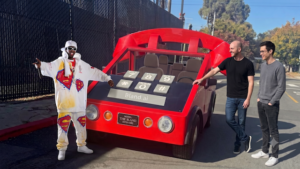
Here’s what stood out from each — and brand teams especially should read this, and here’s the full conversation so you can follow along (the thumbnail on this video is a bit much btw, I’m sorry)
1. ElevenLabs made a Michael Caine brand film in a day. With one person.
Luke Harries leads growth at ElevenLabs. They wanted to announce that Michael Caine’s voice was joining their iconic voice marketplace, so they made a full brand film starring him. The whole thing (script, voice, visuals, music, animation) was made by one guy named Jack in one day.
Voice came from their library (Caine licensed his voice and gets paid every time it’s used). Images were Nano Banana. Video was Veo. Sound and music, all AI.
Here’s the part that matters though. Luke was clear that ElevenLabs does not use AI for a-roll. No talking heads. No people in front of the camera. The quality bar isn’t there yet. They use AI for b-roll, voice, sound, music. The stuff where you can’t tell. And they put a real human layer on top of all of it.
That’s the move. Pick the parts of the production where AI is actually good. Leave the rest alone. You can see the video here on my YouTube channel.
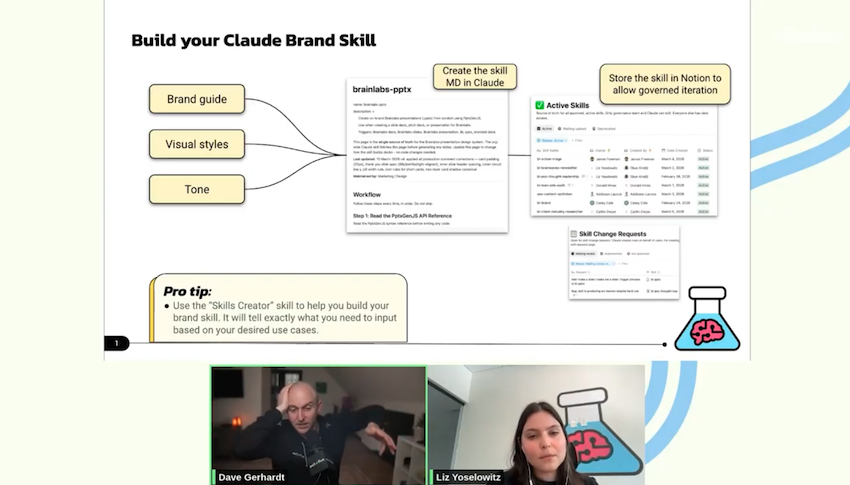
2. Brain Labs built a Claude skill that lets the whole company create on-brand marketing material.
Liz Yoselowitz is CMO at Brain Labs. Her design team kept getting hit with the same kinds of requests over and over. Make me an infographic for a LinkedIn post. Build me a one-pager. Spin up a sales deck. BEEN THERE. I felt like my job was deck maker. Sales needs a new deck. They want a different one pager…
So they built what she calls a “mega skill” in Claude. They loaded in their brand guidelines, visual style, and tone, then trained it on the specific outputs the team needed most. Now anyone at the company can prompt Claude and get on-brand infographics, sales decks, and dashboards back. The design team isn’t the no-department anymore. They set the system, they govern it, and they get to spend their time on the foundational work that actually moves the brand forward.
The governance piece is what I liked the most. There’s a “skill change request” workflow inside Notion. If someone using the skill notices the bar graphs are coming out wonky, they file a request. The design team reviews and approves what gets added back into the skill.
Crowdsourced quality control with a real owner.
Liz’s team redesigned their entire website (look and feel, not dev) in a month using this. She also said something that stuck with me: she feels like she’s restarted her career in the last eight months. Sounds like someone feels what I’m feeling from my intro.
3. Bit.ly is making customer education videos without hiring actors (and they are really good!)
Vicente Casella is creative director at Bit.ly. He showed us a two-minute customer education video that cost a couple hundred bucks in credits and took about two weeks to produce. Pre-AI, this video would never have existed. The investment wouldn’t have made sense for that use case; they would have needed actors or in-house experts with product knowledge.
His workflow looks a lot like a traditional production pipeline, just compressed now because of AI. He started with his idea, then prompted Claude to write the script (and keep editing it back and forth, never one-and-done). Then he built a storyboard with Nano Banana, generating each key frame as an image. Then turned those images into video clips. Then edited it together like any normal post-production job.
Two things stood out. First, the workflow itself isn’t that different. You still need taste, art direction, scripting, editing. You’re just doing it as a generalist instead of waiting on a six-person crew. Second, the unlock isn’t replacing big-budget productions. It’s making the videos you couldn’t justify before. Customer education. Internal explainers. Long-tail stuff. That’s where the leverage shows up. I was happy to see a creative director embracing AI. He said basically hey, I can do this all myself now, which is pretty cool. We’re giving more people super powers! I hope.
4. UiPath generated their own venues, and figured out which voices to clone vs. dub.
Carter Elkin-Paris is a senior producer on the brand studio team at UiPath (he runs video there). He had two useful examples of using AI for creative:
For their global sales kickoff, they needed shots of the specific theater they were hosting at, with their branding on the marquee. No stock library has that. So they generated it. Beautiful, on-brand, exactly the venue, exactly the framing they wanted. The shot they always wanted but could never get, without having to travel.
The other one is voice. UiPath does a ton of localization for different markets. Carter’s team spent months experimenting with what works and what doesn’t, testing different voices across different areas. But you can’t just outsource all of this to AI, there’s room for taste in the middle. For example, Carter found there’s a lot of tweaking to pay attention to; cloning an American voice into an Asian voice did not work well. So in those cases, they used a pre-trained Asian voice from the library to dub it. But going Spanish to French (romance language to romance language) the cloning sounds great. Who knew!
Look: none of these marketers have had 100% of their work replaced by Claude Code like they are saying on LinkedIn. They did not replace the creative team with a subscription to some $20/month image generation tool.
But everyone is focused on embracing AI now and giving creatives better tools to do work they couldn’t do before. Videos that didn’t fit the budget last year. Brand films shipped in a day instead of a quarter. Custom shots that no stock library could ever produce. That is pretty cool.
I’ve been thinking about the idea of everyone being more of a full-stack marketer because of AI. I can now write a script and make a video for an ad without needing a bunch of other resources? I’m intrigued.
That’s the bull case. AI doesn’t replace the team. It expands what the team can ship.
– Dave
P.S. Do you believe in AI for creative in marketing? What’s the most useful AI creative thing you’ve shipped this year? Reply back and LMK. We love getting more real examples.
Watch the full recording from our session on AI and creative here.