The 12-Point AEO Checklist Worth Stealing If You Want LLMs To Cite You
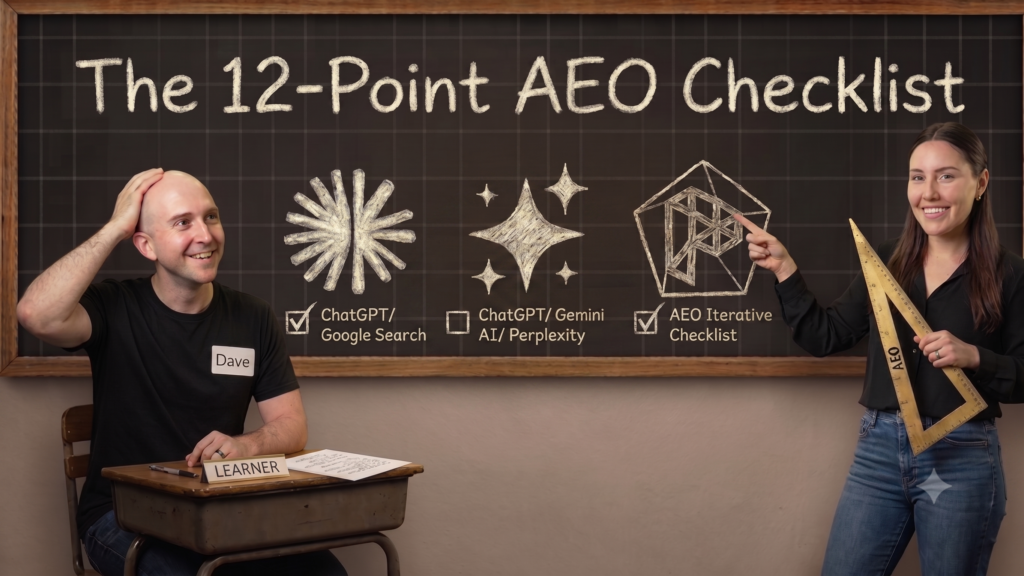
An AEO checklist is the short list of things to check so AI engines like ChatGPT, Claude, and Perplexity can read your pages and cite them. This one comes from Rebecca Busk, CEO and Partner at Kvalifik, and the 12 points boil down to: make sure your site is crawlable and indexed, write in plain language, define your terms, put the answer first, add dates, authors, and sources, back every claim with real proof, use the right schema, and earn authority that feels real, not PR-shaped. Marketers in our community post every week about AEO landing on their to-do list. Here’s where to start.
Rebecca Busk, CEO and Partner at Kvalifik, an agency in Denmark that’s been doing branding, design, and web for 11 years, spends most of her day getting clients’ products and services actually cited inside ChatGPT, Claude, and Perplexity. She came on our podcast recently and handed over her full checklist for getting cited instead of ignored. Here are 12 things to check on your site now.
1. Don’t write your AEO content with AI.
This seems counterintuitive, but here’s why. LLMs are trained on content that already exists. So, if you ask AI to write a blog post about why your software is the best in its category, you’ll get something that sounds like the other 2,000 sites saying the same thing. The fix isn’t avoiding AI, it’s feeding it good content. “We build websites” gets ignored. “We rebuilt an 800-page site for this client and grew demo bookings 170%” gets cited. GOOD NEWS FOR HUMAN MARKETERS!!
2. Check crawlability and indexing first.
Nothing on this list matters if the engine can’t read your site to begin with. Start in Google Search Console and confirm your key pages are actually indexed before you touch anything else.
3. Improve readability.
Skip the buzzwords. “Utilize” instead of “use” doesn’t make you sound smarter. It just makes the content harder for the machine to parse. AI wants the same thing a tired human scrolling on their phone wants: plain language, said quickly.
4. Add clear definitions.
Don’t assume the reader, or the engine, knows your category’s jargon. If you’re writing about your AEO strategy, explain what AEO actually is first. A lot of readers, and a lot of prompts, are starting from zero.
5. Use Q&A sections.
Rewrite your titles as the actual question a buyer would type into ChatGPT, then answer it directly underneath. You don’t need a dedicated FAQ page to do this. Structure every page on your site as a question someone’s already asking.
6. Move the main answer up.
Rebecca’s rule of four: answer first, explain second, prove third, expand fourth. That’s the order AI wants to skim your page in, and it’s also just how people read now. Nobody’s scrolling four paragraphs into a blog post to find the actual answer.
7. Add dates, authors, and sources.
LLMs don’t want to cite content that looks stale. A visible publish date or last-updated date signals the page has actually been reviewed, even if the core advice hasn’t changed in years.
8. Add key takeaways.
A short summary near the top of the page, and again at the end. Rebecca’s rule of thumb is to get the good stuff in within the first 30% of the page, or the engine moves on to find the answer somewhere else.
9. Use proof and real examples.
Replace vague claims with numbers, cases, and quotes. This is the one piece AI genuinely can’t fake for you. “We build great websites” is invisible. A named client and a specific result get quoted back.
10. Strengthen internal links.
Connect the page to case studies or testimonials it actually references. It helps humans confirm you’re telling the truth, and it helps the AI verify the claim while it’s skimming your site. Internal links help SEO too.
11. Use the right schema.
Match it to the page type: organization, article, product, service, FAQ, breadcrumb. It’s the difference between an engine guessing what your page is versus being handed the answer directly.
12. Earn authority that feels real, not PR-shaped.
Rebecca pointed to a test Webflow ran with Graphite on Reddit. Instead of posting “Webflow is the best platform,” their reps went in and answered real questions people were already asking. That’s the kind of signal AI can actually verify.
Frequently Asked Questions
What should be on an AEO checklist?
Rebecca Busk’s 12-point AEO checklist covers: don’t write your AEO content with AI, check crawlability and indexing first, improve readability, add clear definitions, use Q&A sections, move the main answer up, add dates, authors, and sources, add key takeaways, use proof and real examples, strengthen internal links, use the right schema, and earn authority that feels real, not PR-shaped.
Should I write definitions early in the content for AEO?
Yes. Don’t assume the reader, or the engine, knows your category’s jargon. If you’re writing about your AEO strategy, explain what AEO actually is first. A lot of readers, and a lot of prompts, are starting from zero.
Do FAQ sections improve AEO performance in LLMs?
Q&A structure helps, but you don’t need a dedicated FAQ page. Rewrite your titles as the actual question a buyer would type into ChatGPT, then answer it directly underneath. Match your schema to the page type too, including FAQ schema where it fits, so the engine is handed the answer instead of guessing.
Should you use AI to write AEO content?
Not on its own. LLMs are trained on content that already exists, so AI-written copy tends to sound like the 2,000 other sites saying the same thing. The fix isn’t avoiding AI, it’s feeding it good content: specific results, named clients, and real numbers are what get cited.
Where should a small marketing team start with AEO?
Start where the checklist does: confirm in Google Search Console that your key pages are actually indexed, because nothing else matters if the engine can’t read your site. Then move the main answer up using Rebecca’s rule of four: answer first, explain second, prove third, expand fourth.