Don’t make this career mistake
The Biggest Career Mistake I Almost Made
Quick story.
Somehow this was 10 years ago now. Back then I had hair and no kids. Quite literally it was a lifetime ago. Fall of 2015. I joined Drift as an early employee in marketing.
My strengths were obvious to everyone except me: I could write, I understood storytelling, I knew product marketing. But I looked around the startup world and decided none of that mattered. I thought my “soft skills” were not that important in “business.” Somehow I got on the path and decided that what mattered was becoming a growth marketer. I set out to become the SaaS growth guy. I started studying Sean Ellis, Brian Balfour, all that stuff. Funnels, analytics, conversion optimization. Things I wasn’t naturally wired for. I was grinding to become someone I wasn’t.
David Cancel, our CEO, pulled me aside one day in a 1:1 and said basically: “You don’t have to be that guy. Stop trying to be something you’re not.” Then he handed me a short book called Managing Oneself by Peter Drucker.
And that idea behind that shift changed how I thought about my career.
Drucker’s argument is basically this in my words: if you’re a D at something, spending two years to grind your way to a B minus is a waste. But if you’re already a B at something, that same investment can make you an A. The math is simple. Go where you have real potential, not where you have the biggest gap.
So I stopped chasing the growth marketer thing. I doubled down on communication, storytelling, brand. That decision shaped our marketing at Drift and helped build a brand that eventually was worth $1.2B, and everything that came after in my career, including Exit Five.
There’s certainly nuance to this advice depending on where you are in your career, but I think it can apply everywhere.
If you’re earlier in your career, stop trying to be well-rounded.
Pick a discipline and go deep.
Jess Cook is a great example. She’s an Exit Five member who just got promoted to VP of Marketing at Vector. She came up through brand and content marketing, and you can see it in everything Vector puts out. She didn’t try to become a demand gen person or an ops person. She went deep on her thing and it became her superpower.
If you’re a CMO or leading a team, the lesson is the same but the application flips.
Your job isn’t to be great at everything. It’s to know your one or two areas of real strength and hire exceptional people around you for the rest.
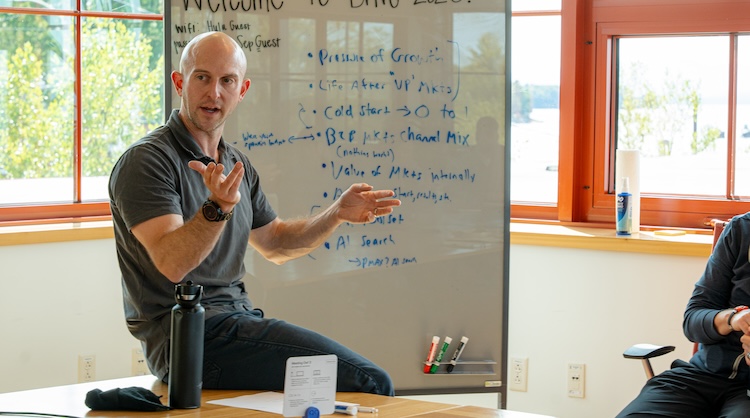
Kim Storin, CMO at Zoom, talked about this at our Marketing Leadership Retreat two weeks ago. Her background is strategy, M&A, and comms. That’s her zone of excellence. She has strong leaders running brand, product marketing, and demand gen. She’s not pretending to be an expert in all of it. She knows where she adds the most value personally and she built around it.
This matters even more right now because of AI.
The generalist marketer, the person whose value is “I know a little about a lot,” is in a tough spot.
AI can help cover a lot of ground now, but what it can’t do is go as deep. The marketers who are going to matter in the next few years, at every level, are the ones with a clear area of strength and real depth in that area. Go deep in an area (powered by AI). Figure out what you do better than most people. Then commit to it. Everything else is noise.
Doubling down on your strengths > trying to become well rounded.
Sample size of one; the guy writing this email. But I thought you might be able to relate to this story.
– Dave
P.S. What’s the skill or area you’ve doubled down on in your career? Hit reply and tell me. I read every response. Or let me know if you think I’m wrong about AI and the generalist.