Is it time to ditch direct response ads in B2B?
😵 Should You Kill Direct Response Ads?
Taylor Udell, Head of Growth at Champify, cut direct response ads entirely.
Direct response ads are a pretty standard part of any marketing playbook.
So it’d be completely wild to ditch them, right? Maybe not.
Taylor Udell did exactly that at Champify. Why?
They were expensive, yielded diminishing returns, and didn’t align with their sales-led motion. Instead, Taylor doubled down on thought leadership ads – targeted, high-value content that helped prospects do their jobs better.
The results were pretty jaw dropping: 51% of their open opportunities engaged with these ads before entering the funnel.
And it makes sense… in a world where B2B buyers increasingly tune out hard-sell tactics, delivering genuine value builds trust and drives results.
Let’s break down why Taylor’s approach works and how you can try it:
1. Find Internal Thought Leaders
It’s much easier to build a following for the actual people on your team than it is to get traction with your company’s profile.
At Champify, they have 3 main thought leaders:
- Taylor (Head of Growth)
- Todd Busler (CEO)
- Will Falkenborg (SDR Lead)
Finding the thought leaders in your org will depend on your product, but the leadership team (especially your CEO) is a great place to start. At least 1 person in Marketing should be involved, too.
2. Deliver High Value Content on LinkedIn
Then, it’s all about your thought leaders sharing helpful content people actually care about.
The Champify team focuses on everything from:
- How they’re doing their jobs (For example, “How I booked 14 meetings this week.”)
- Lessons they’re learning (Think: “The most consistent AEs are MANIACALLY focused the “best” accounts.”)
- Recaps of the conversations they’re having (Like, “Last month I spoke with a global SDR leader at a $9B company…”)
Taylor leads with information. Todd leans on his background and shares tons of valuable insights. Will shows his personality with humor.
They focus on delivering value (rather than selling or promoting) first.
3. Run Thought Leadership Ads
Take the team’s best-performing posts and put thought leadership ads behind them.
Something like this:
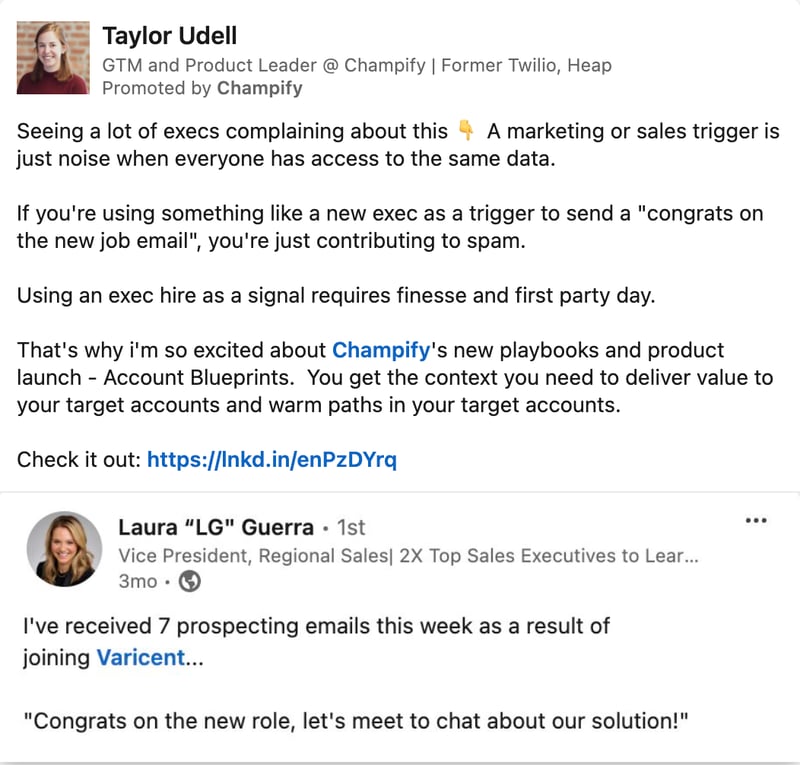
Chamipify has a small target account list (only ~200 accounts), so they target the relevant personas at those accounts with these ads.
And it’s pretty dang successful: 51% of their open opportunities have engaged with those thought leadership ads.
About 90% of Taylor’s ad strategy is this thought leadership playbook. So what does she do the rest of the time?
4. Ungate, Ungate, Ungate
She drives people to playbooks, like “How to build an outbound culture.”
It’s packed with advice from people like Justin Geller at Gong and Doug May at Harness. And it’s super tactical and helpful, whether readers are using Champify or not.
Again, the focus is on value. Which means the page is ungated and accessible to anyone.
Yes, there are forms on the page to join their newsletter, but Taylor firmly believes in earning the right to build a relationship over time, which starts with trust.
5. Measure Success
If you’re ditching the traditional ad playbook, you’ll need a testing strategy to prove what works.
For Taylor, this looks like tracking which ICPs are engaging with their content using tools like Clearbit or Koala (and cross-referencing that with engagement data from their LinkedIn Ads).
From there, she can get insights like whether those accounts close faster, which opportunities have re-opened, and which new accounts she’s getting in front of.
An extra tip: Focus on one experiment or stage of the funnel at a time.
For example, if you’re testing a strategy to boost awareness and you see all your awareness metrics grow, you know it has to be working because it’s the only play that’s changed.
Do you still run direct response ads or have you ditched them? Thoughts? Maybe targeted to someone deeper in the funnel? Would love to know.