4 Proven Growth Plays to Use Right Now in B2B Marketing
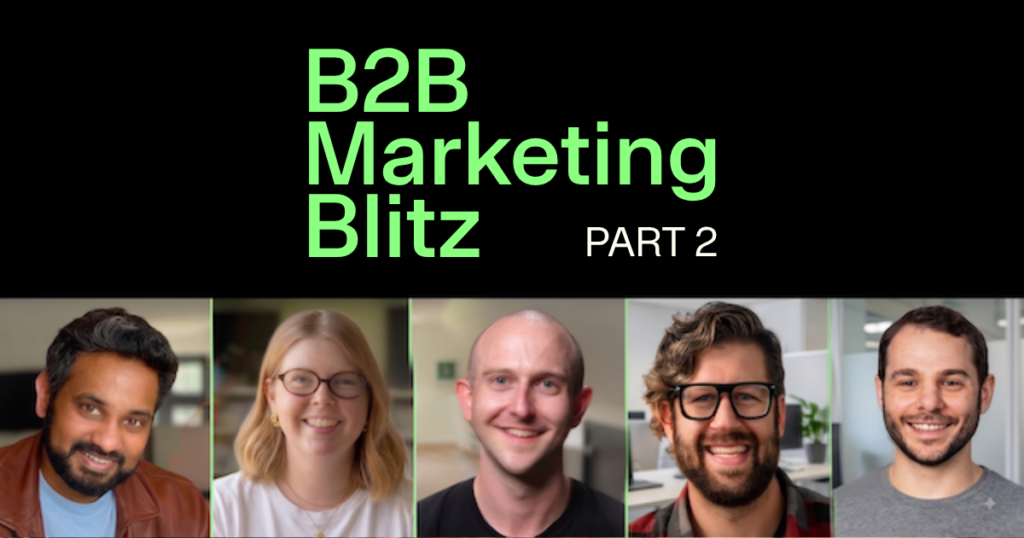
Need marketing ideas to hit your metrics, but want to skip the trial-and-error? Steal these four plays, complete with the exact mechanics of how to run them yourself.
We cover: a Claude skill that boosted AI visibility by 30%, LinkedIn articles built for AEO, the “3S” framework for better content creation fueled by VOC, and a physical book launch that turned into a year of ABM touchpoints. Here’s how these B2B marketing pros pulled off these four proven plays.
1. Winner: The Claude skill workflow behind a 30% AI visibility jump
Molly Evola, Sr. Content Marketer, Customer.io
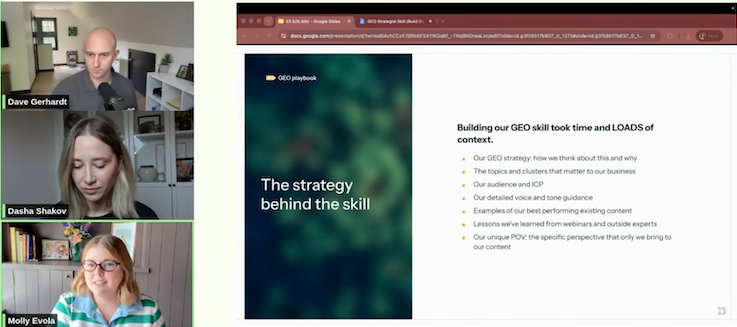
Molly’s team built a Claude skill to optimize existing blog content for AI visibility, complete with the key information that feeds it: their GEO content strategy, topics that matter to the business, audience and voice guidelines, and examples of their best content that are already ranking well in AI search. Crucial to the process: a human always reviews the output before anything ships. Watch Molly’s play here.
The workflow:
- Run the skill: Paste in the live URL, current title and meta description, and full body copy, then prompt the skill to optimize for AI visibility: proper formatting, new features or case studies, and an updated meta title and description too.
- Review the output: Molly checks for two specific edits: does it fully answer the question that the page is being optimized for, and does it weave in real case studies, the company’s POV, and fresh messaging?
- Structural edits are the most visible ones: optimized H2s, a new TL;DR section, updated stats and tables, and callouts.
- Copy edits matter: the skill swaps a generic stat for a real case study, and a neutral intro always gets rewritten to take a real stand.
- Reporting: Tracked through Google Search Console’s generative AI report and a tool called Profound, rolled up into one overall AI visibility score rather than judged page by page.
The results: One page hit the 100th percentile for citations, 11,000 in five months, with active users up 104%. Customer.io now shows up in one of every three AI conversations about the category, a 30% visibility jump, and ranks as the number one recommended brand when people ask AI for alternatives to competitors.
2. LinkedIn articles are AI search’s favorite citation right now, here’s how to write them
Anthony Blatner, Founder, Speedwork
Data shows long-form articles on LinkedIn are now one of the most-cited content formats in AI search, a format almost everyone ignored a year ago. The catch is who should be publishing them.
The mechanics:
- It’s important who posts: 75% of LinkedIn citations go to individual people, not company pages. So most of your effort should go into getting executives and employees posting, not the company page.
- Tracking: Google indexes LinkedIn posts fast. Set up alerts for your name and company so you know within a day when something’s been picked up.
- Easiest tactic: repurpose existing blog posts as LinkedIn articles. Post about 90% of the content, hold back one tip or step, and link to the original post for the rest.
- Formatting and hard data get cited more: headings, bullet points, and proprietary numbers. Tag your company and the people involved, or the citation becomes what Anthony calls a ‘ghost citation,’ data for the algorithm that never ties back to you.
- Boost your best posts: boosted posts see 41% more engagement, layer thought leader ads on top for even more reach. The sweet spot for article length is 800 to 1,200 words.
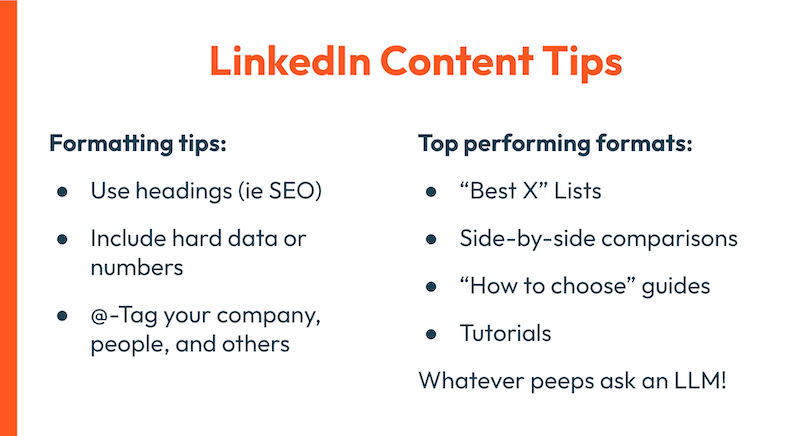
Check out Anthony’s full slide deck and his play in the B2B Blitz Pt. 2.
3. The 3S Strategy: The exact questions to ask Sales, Success, and Support for content creation
Brendan Hufford, Head of Marketing, Growth Sprints
It’s hard to get approval to interview customers directly, for lots of reasons (eg, we don’t want to bother them!). Brendan’s 3S strategy works around that: specific questions, recorded in an organized way, not a generic ‘catch up’ between marketing and sales. Watch Brendan’s play now.
The questions and system behind them:
- First, what can we do for you: what’s something we can do or create to help your team? Ask this up front to build good will and help your coworkers reach their goals!
- Positioning check: Ask what objections keep coming up, what competitors are showing up more than before, and what new phrase or terms people are using that they weren’t six months ago.
- Read the room: Watch for the moment someone leans into a demo, when their expression changes or they stop looking distracted. That’s the insight worth using.
- Don’t stop at Sales: Run tailored questions with Success and Support. Most marketing is obsessed with acquisition and ignores what people search for during renewal.
- Automate it: Every call gets recorded, analyzed in Claude, and summarized into a shared, running team insights document.
The results: You become the customer whisperer, the hardest person in the building to lay off. Once everyone can pipe calls into Claude, the edge isn’t the data, it’s the ability to spot the patterns.
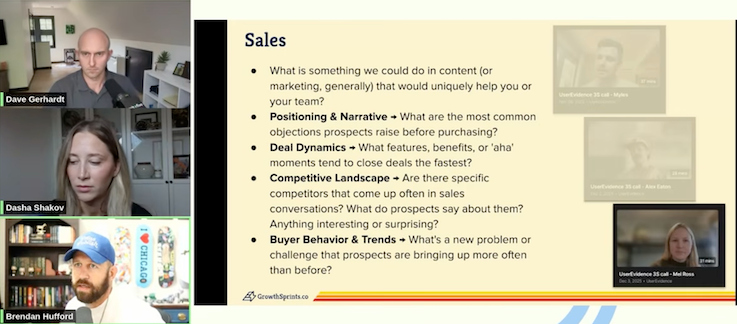
More of the questions Brendan uses to interview Sales (instead of customers).
4. Turn One Book Launch Into a Year of ABM Touchpoints
Aditya Vempaty, VP Marketing, Coram AI
Aditya’s team built a physical and digital ABM book, mailed to target accounts and downloadable online, and it worked: it got downloads and generated pipeline. But once someone had it, that was the end of the touchpoint, since accounts buy on their timeline, not yours.
People also wanted to go deeper into their specific problems, and wanted to hear from customers, not just practitioners. The fix was a magazine series: same physical-mail playbook, but released in stages, so there was always a new reason to touch base with an account. Watch Aditya’s play here.
How he did it:
- Validate first: Talked to 5-6 executives before committing, to confirm a theme like ‘human vs. AI’ was a real problem people wanted to dig into.
- Use partnerships: Leaned on the partnerships team to bring in practitioners and influencers who already have their own audience and distribution.
- Release in waves: Three issues on their own timeline: Human vs. AI first, Personalization next, then AI risk for leaders deploying AI at scale.
- Match to accounts: Pick authors who resemble your actual target accounts, and train sales to use each issue as their reason to reach back out to that account.
- Keep it cheap: Printed through the same fast-turnaround printers used for the book, at roughly $3 – $4 a copy, with about a month of lead time before each launch.
The results: Over 1,000 downloads, 112 new ABM accounts engaged, and $7.8 million in revenue traced back to the campaign.
That’s the extended cut on 4 plays from marketers actually doing the work, inside B2B companies, shipping real campaigns. Pair that with whatever you’re doing with AI, and that’s the winning combination. Steal whichever one fits where you’re stuck right now.
If you liked these plays, we’re getting ready for our next Exit Five Live session, Writing for Humans: The Real AI Workflows Behind Great B2B Content, on 8/21 at 12pm ET. Look out for the details.
– Dave
PS. Did you find these plays useful? Maybe you have an awesome play you want to share to help other B2B marketers get unstuck and find inspiration. Apply here to be part of our Experts Network.