9 Marketers Share Their Top Plays of 2026 (So Far)
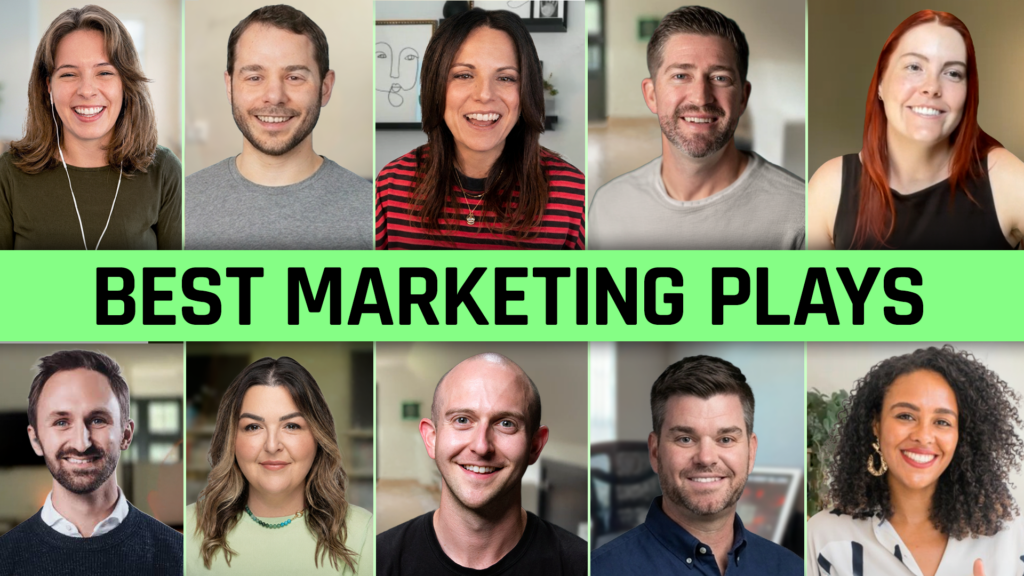
Last week we ran a Live Session called the B2B Blitz. Nine marketers each shared the best play they’ve run so far this year. The catch: I had my buzzer ready for the two-minute mark.
“Insanely valuable.”
“A masterclass in modern marketing.”
“Best webinar format I’ve ever sat in on.”
Just a glimpse of the feedback.
The overall sentiment in the room was that real examples from real people beat anything you can prompt out of Claude. Here’s an overview of what each of these marketing pros brought to the Blitz.
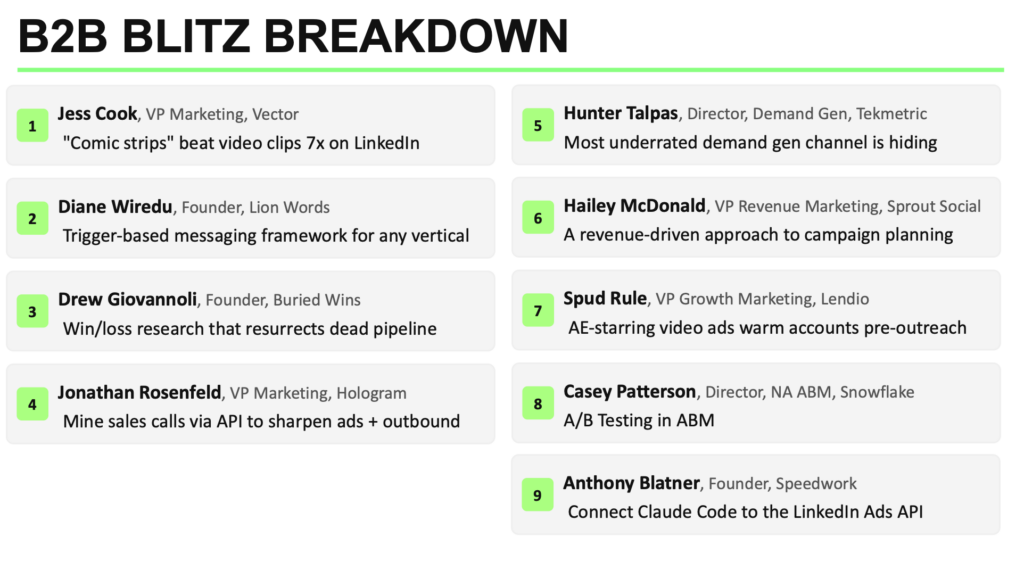
Play 1: “Comic strips” beat video clips 6X on LinkedIn
Jess Cook, VP of Marketing, Vector
The problem: Vector’s podcast clips were mobile-friendly and well produced, and still weren’t getting the reach they wanted.
The play: Jess noticed how Amy Poehler promotes her pod on Instagram using comic graphics, screenshots strung together into a few panels instead of a video clip, and copied the format for her own show. The result was 6X the engagement and impressions.
From the chat:
- “Damn. Two minutes and she gets the boot? Brutal.” – Brent B.
- “Dropped the mic at 6X engagement.” – Shawn P.
- “Loving your new format Jess! it worksss.” – Brianna K.
Whoops, looks like Jess brushed up against the 2 minute mark. Did she make it back for the second round?
Play 2: Trigger-based messaging framework for any vertical
Diane Wiredu, Founder, Lion Words
The problem: Vertical messaging for complex, multi-industry B2B companies is usually either too simple to write real copy from or too complicated to ever get used.
The play: Instead of the usual “what pain does this segment have” exercise, Diane has teams map the actual buying trigger per vertical, pulled straight from customer interviews. The result was aligned, on-brand messaging her teams could reuse across assets well beyond the homepage.
Alyssa I. said she “would love to see more of this play.” She wasn’t alone!
Play 3: Win/loss research that resurrects dead pipeline
Drew Giovannoli, Founder, Buried Wins
The problem: Most teams treat win-loss research as academic. It doesn’t tie to ROI, and lost deals get left for dead even when the reason they were lost no longer holds true.
The play: A $75M+ aviation maintenance SaaS company grouped 300 lost deals by reason, gathered new proof points per cohort, and re-engaged through calling, texting, and email. The play resulted in 24 MQLs out of pipeline everyone had written off, an 8% conversion rate.
From the chat:
- “Drew I love the validation. Been preaching this to my team!!!!!” – Linzy C.
- “Closed lost deals is a treasure chest.” – Edita V.
Play 4: Mine sales calls via API to sharpen ads and outbound
Jonathan Rosenfeld, VP of Marketing, Hologram
The problem: Most teams understand their customers through anecdotes, one good quote from one call, instead of anything systematic.
The play: Jonathan’s team pushed years of Gong recordings into Supabase and connected it to Claude through a daily-updating MCP server, so messaging, roadmap decisions, and channel performance come from real conversations, not one salesperson’s story. They also built a real-time objection handler off the same data.
From the chat:
- “Love the voice of the customer focus!” – Maria V.
- “Loving this! Doing VOC within Gong but would love to pull into Claude.” – Chloe N.
Play 5: Your most underrated demand gen channel is hiding in plain sight
Hunter Talpas, Director of Demand Gen, Tekmetric
The problem: Marketers pour budget into external channels and overlook the distribution network already sitting on payroll.
The play: Before running a single external campaign for Tekmetric’s first industry event, Hunter’s team sent one no-fluff monthly update company-wide. Sales started mentioning the event on calls, Product put it on the login screen, the CEO personally invited people, because everyone felt like they co-owned it. The results were clear: 852 attendees, a 94.5% show rate, 97% earned media share of voice.
The chat understood the value: “Your team IS speaking to the warmest event attendee leads.” – Miranda S.
Catch the full Blitz episode here.
Play 6: A revenue-driven approach to campaign planning
The speaker: Hailey McDonald, VP of Revenue Marketing, Sprout Social
The problem: Most campaign plans start with what marketing is doing, not who they’re selling to, so ROI turns into something you explain after the fact instead of something you planned.
The play: A matrix tying every ICP segment to a revenue signal, built with Rev Ops and Product Marketing, not Marketing alone. Every segment gets a percentage tied to the actual revenue target, so the budget gets built from that number down.
Meredyth J. applauded Hailey’s “Excellent framework!” and Stephanie M. said, “Love these visuals & strategy! Gimme more.”
Play 7: AE-starring video ads warm accounts pre-outreach
Spud Rule, VP of Growth Marketing, Lendio
The problem: Most ABM is glorified cold outreach – ads, emails, and events that feel disconnected from each other.
The play: Put the AE who will actually run the deal in front of target accounts months earlier, through long-form LinkedIn video. The video isn’t the campaign, it’s the anchor everything else builds around. One 10-minute video generated 5 discovery calls in two weeks on $4K spend.
Keith S. from the chat nailed it: “Sales reps are the celebrity, peloton style. This is great.”
Play 8: Back to basics A/B testing in ABM
Casey Patterson, Director of NA ABM, Snowflake
The problem: Everyone’s rushing to talk about AI right now, but nobody fully knows yet what actually lands with buyers.
The play: Casey ran an abstract, product-heavy message against an outcome-led one with a tangible hook, and outcome-led won by a wide margin, an 8X lift in click-through rate. The bigger win was handing that result to product marketing to refine messaging before it rolled out broadly.
We recently had Casey on our podcast to talk ABM and it’s one of our most popular YouTube episodes ever. Check it out here.
Play 9: Connect Claude Code to the LinkedIn Ads API
Anthony Blatner, Founder, Speedwork
The problem: Managing LinkedIn ads well, pacing budgets, cleaning demographics, applying exclusions, eats hours every week, and LinkedIn doesn’t even give you a change log.
The play: Anthony skipped the pre-built MCPs and connected Claude Code directly to the API for full read and write access. It now handles bid pacing, scans demographics for spend going to the wrong job titles, and clears exclusions across every campaign at once. His big rule: a human approves every budget change in Slack.
Needless to say, the chat went crazy at the mention of Claude Code…
Like I said at the start, Claude can’t replicate this format. AI can’t recreate a room of marketers who’ve actually done the work. And I’m not dunking on Claude (no offense, Claude if you’re plugged in somewhere reading this). It’s just that … I think there’s a lot of hype right now, and it’s important to focus on what’s real. You can ask Claude any marketing question you want, but Claude is not currently in-house tasked with delivering pipeline and trying to keep their job. So our mission at Exit Five is to show you the real stuff.
That’s the bet we’re making with our live sessions (and our whole community really) going forward. Real plays from real people.
Get in on the next Exit Five Live Session here: Paid Ads Playoff: Proven B2B Plays That Turn Spend Into Pipeline
– Dave
Frequently Asked Questions
How did Jess Cook boost LinkedIn engagement 6X with a comic strip format?
Vector VP of Marketing Jess Cook noticed Amy Poehler promoting her podcast on Instagram using comic-style graphics, screenshots strung into a few panels instead of video clips. She copied the format for her own show’s LinkedIn promotion, and it generated 6X the engagement and impressions versus standard podcast video clips.
How did Buried Wins turn 300 lost deals into new pipeline?
Buried Wins founder Drew Giovannoli described a $75M+ aviation maintenance SaaS company that grouped 300 lost deals by reason, gathered new proof points for each cohort, then re-engaged prospects through calling, texting, and email. The win-loss research play generated 24 MQLs from pipeline everyone had already written off, an 8% conversion rate.
How does Hologram use Gong and Claude to analyze sales calls?
Hologram VP of Marketing Jonathan Rosenfeld’s team pushed years of Gong call recordings into Supabase and connected it to Claude through a daily-updating MCP server. This lets messaging, roadmap decisions, and channel performance come from real customer conversations instead of one salesperson’s anecdote, and powers a real-time objection handler built on the same data.
What internal channel helped Tekmetric hit 852 event attendees?
Before running any external campaign for its first industry event, Tekmetric’s demand gen team sent one no-fluff monthly update company-wide so employees felt they co-owned the event. Sales mentioned it on calls, Product added it to the login screen, and the CEO personally invited people, driving 852 attendees, a 94.5% show rate, and 97% earned media share of voice.
How did Lendio generate 5 discovery calls from one LinkedIn video?
Lendio VP of Growth Marketing Spud Rule put the account executive who would run the deal in front of target accounts through a long-form LinkedIn video, using it as the anchor for the rest of the ABM campaign rather than the campaign itself. One 10-minute video generated 5 discovery calls in two weeks on just $4K in spend.
What A/B test gave Snowflake an 8X lift in click-through rate?
Snowflake’s Director of NA ABM, Casey Patterson, tested an abstract, product-heavy message against an outcome-led message with a tangible hook. The outcome-led version won by a wide margin, an 8X lift in click-through rate, and the result was handed to product marketing to refine messaging before rolling it out more broadly.