An Agent That Edits Drafts Before You Do

Despite what you might read on LinkedIn, most marketers are still figuring agents out. Of the 1,000 marketers we asked, more than half hadn’t built an AI agent or tried and got stuck. Three quarters didn’t know where to start or didn’t have time to learn. If that’s you, you’re in the right place.
First, let’s define “agent” because it gets thrown around a lot. My co-host Dasha put it best: if AI is like chatting with a smart consultant, an agent is like handing that consultant access to your computer so they can do work on your behalf.
Maddy Osman, Senior Content Marketing Manager at DigitalOcean, built one of the agents our Exit Five Live audience said they wanted to build. Her agent is a chain of 17 Claude skills that does the first editing pass on every draft she has to review. Here’s how it works.
First, the agent runs the entire editing checklist on every draft
Anyone writing drafts knows that each one has a long list of things to check: grammar, style, brand voice, SEO, links, accuracy, and whether it actually covered the brief. For Maddy, the stakes are high. Most of what she’s working on now is comparison pages – where she says a wrong claim is a real risk. And like a lot of companies, DigitalOcean is heavily focused on LLM visibility.
So her skills chain is the first step on every draft. Whenever a draft is submitted, the editor agent runs 17 checks before anyone edits to answer questions like:
- Did it cover the brief?
- Does it match the style guide?
- Is it on brand?
- Is it built to actually get found?
Maddy said she’s built more technical agents in Zapier and n8n, but this one you can build in Claude without being a technical marketer or coder. And she still edits every draft after the chain runs. As she put it, the human touch can’t be replaced no matter how many ways you try to work around it.
Some results from her comparison pages using this method: top citations on tracked AI prompts and top organic results within 24 to 48 hours of publishing.
The difficult part, she said, is getting a dozen-plus skills to work together instead of tripping over each other.
The messy middle: Giving each skill one job
The style guide, brand positioning, SEO guidelines, legal guidelines, and rules for talking about competitors don’t always agree. They’re also spread across Google Docs, Confluence, Notion, webpages, and more.

The chain is her getting those standards out of her head and out of those docs. Each skill gets one job, and a project manager skill decides the order so they don’t overlap. Maddy’s agent is up to 17 skills now, and she adds at least one a week as new problems come up.
Two examples:
- The reader advocate checker reads the draft like an uninformed reader would. It flags concepts that never got explained, acronyms that aren’t spelled out, and claims that get raised and dropped.
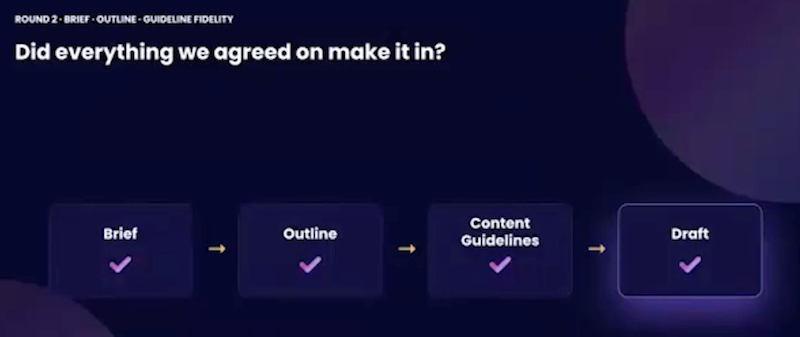
- The fidelity checkers confirm that everything in the brief, outline, and guidelines made it into the final draft. That used to mean a lot of open browser tabs.
AI still makes mistakes, so Maddy still checks. The difference is she goes into the human review round with the issues already flagged.
What makes it work: Live docs and the full workflow
Maddy says this might be the most important detail. Guideline docs change all the time – new ones get added and briefs get updated.
That’s why each skill checks whether its source doc changed since the last run and re-pulls it if it has. That keeps the knowledge from being frozen in place, versus uploading docs to a Claude Project. The editor chain is also only half of Maddy’s workflow though.
The full process:
- Maddy writes the brief, with help from a skill.
- A drafting workflow adds on-brand CTAs, internal links, and relevant media, and takes a first stab at the intro.
- The editor chain runs its checks on things like brand fidelity, SEO, fact checks, legal review, style, and more.
- Maddy does her final human edit.
Maddy’s key learnings:
- Use a project manager skill. One skill manages ordering and overlap so the others work together effectively.
- Cache your prompts. Claude can reuse instructions it’s already processed instead of paying for them again.
- Markdown in, DOCX out. Work in markdown to save on tokens, and output to DOCX so the feedback comes back as inline comments.
Your move: turn your most tedious check into your first skill
Seventeen skills is a lot. But each one started the same way: Maddy hit a new challenge in her editing process and built a skill to solve it. She chained them together and added a project manager so that now they make up her editing agent.
If you’re part of the majority of marketers we surveyed who haven’t built an agent yet because they didn’t know where to start, this is the move. Identify one check you do by hand and make it your first Claude skill. If content quality, brand, or AI visibility is part of your job – go and steal this approach right now.
Check out the full Exit Five Live session: How I Built that [Agent] – 7 Marketers Show AI Workflows That Save Hours