How to Turn LinkedIn Into Your Best Growth Channel in Fall of 2026

I’ve been writing on LinkedIn for over a decade, and I still think it’s the most effective channel in B2B marketing for most industries (as we’ve discussed recently, not every industry, but many). Since most of you are in this world, today we dive into the LinkedIn for B2B playbook – specifically how to make it one of your best growth channels. Let’s get into it.
Why LinkedIn is Worth Betting On
If I were running marketing at a B2B startup today, LinkedIn would be our primary PR channel – the founder and ELT all posting 3–5x a week. Even for larger companies, nothing beats it for influencing your ICP. I’ve felt this way for years, but it’s even more true now that LLMs are citing LinkedIn as a source (!)
Try to stop thinking about it as “getting the CEO to post” and start thinking about it like working with a PR agency. You don’t measure PR ROI by leads generated – the value is in testing messaging, connecting with customers, finding partners, building an employer brand, and landing DMs out of the blue.
People buy from people. There’s a huge opportunity to make social media your main B2B marketing channel. Here’s how I think about it.
How to do LinkedIn well
Who at my company should post? (Hint: people over company pages)
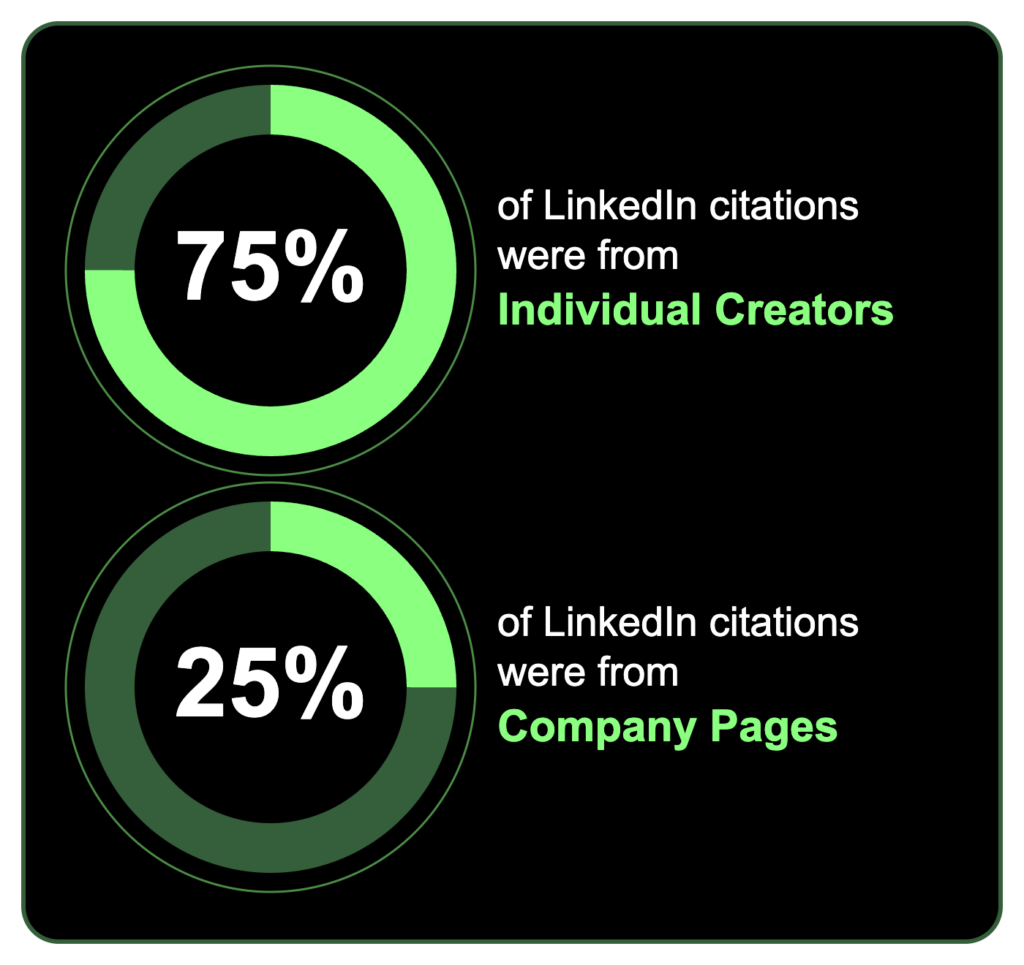
Personal profiles get way more engagement than company pages. Think about who should post in three buckets:
- Relevant expertise. Who has insights your buyers need – founder, CTO, CIO.
- Proximity to the customer. CRO, Head of Customer Success, CEO.
- The X factor. Someone funny, charismatic, relatable, or well-respected in the space.
The catch: they need to actually want this, or it won’t last. If it’s only one person posting, start with whoever has the most relevant expertise – usually the CEO or founder.
What to post (and how to never run out of ideas)
Anything can work – 11-minute videos, three-line text posts. It’s a numbers game: reps and ideas.
What makes you stop scrolling? Write it down – content, angle, tone. Save what you love and use it for inspiration.
Create a system. Ideas can come from anywhere in your company.
- One company’s Slack channel, “stuff customers say,” became the CEO’s main source of content ideas.
- Keep a running list of ideas – write it down when something pops up.
- Analyze your CEO’s recorded calls with AI for patterns – a repeated story is a signal it’s meaningful.
- Save your best comments on other posts. Turn three-line comments into 500-word posts next week.
Become an expert your customers trust. Help them get smarter about your industry and better at their job.
The CEO or founder is usually the best fit because their industry expertise, often built over 20 years before starting the company, makes great content. But other execs and influencers inside the company can work too.
A few examples:
- Grant Lee, founder of Gamma (an AI presentation app), talks about broader AI trends and how they’re building as a smaller company – not just Gamma.
- Try the likable and relatable angle: SurveyMonkey CEO Eric Johnson (after a push from his marketing team) started sharing his thoughts from running while marathon training.
- Kieran Flanagan, SVP Agentic GTM & Systems at Hubspot, talks about AI trends and developments for B2B marketers. Deep domain expertise, and great delivery and sense of humor.
Variety is good! Promoting your product 100% of the time won’t work, so be strategic. Engagement and results aren’t the same thing. A post might get 30 likes and 3 comments, then generate 300 new CRM contacts. Or, only AI bots comment – but 5 prospects DM you.
Bottom-of-funnel content gets less engagement because you’re talking to a smaller, more specific audience – that’s fine. Balance helpful content with the occasional promo post, and you’ll drive real results.
How to think about measurement (and explain it to the ELT)
So much of LinkedIn is gut instinct. You can’t say that to the CFO – here’s what to do instead.
- Proof is in the bottom line. When the CEO’s post brings back a dormant investor or a cold prospect finally responds, they’ll get it.
- Position it as an experiment – a quarter is easier to commit to than “forever.”
- Add self-reported attribution – LinkedIn as an option on forms and in sales conversations. Not perfect, but it shows up often.
- Use tools like Fibbler to see which LinkedIn posts are influencing deals in your CRM.
- Track engagement-to-pipeline signals – push ad engagement data to Clay to prioritize outbound on repeat engagers.
You don’t need leadership all-in on day one. Start small, prove it works, and the wins earn you the freedom to do it right.
Why ramp up LinkedIn now?
Reason 1: LinkedIn articles are secretly the most-cited format in AI search
And if you need even more reasons why now is the right time to ramp up publishing on Linkedin, check this out…
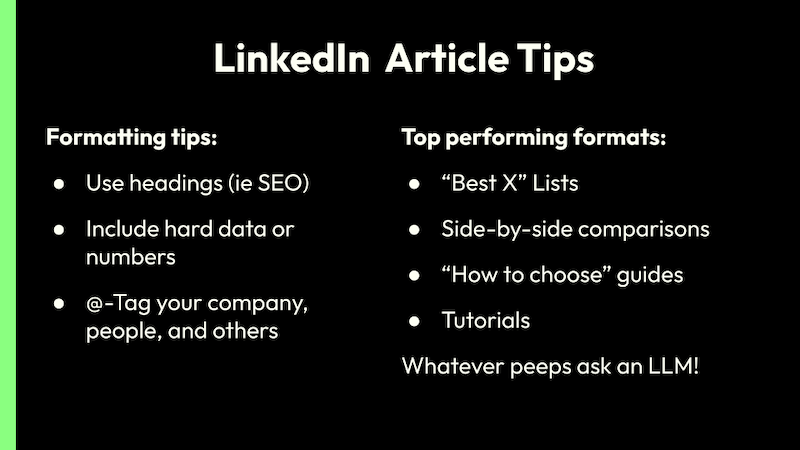
A year ago, almost nobody used LinkedIn’s article feature. Now the data says otherwise – long-form articles are the most cited content type on LinkedIn across AI search. It makes sense, this is long-form content on a high-authority domain, tied to a verified profile and company page.
One easy way to execute this is to repurpose your existing blog posts. The format carries over almost exactly – headings, bold text, structure and all. Post about 90% of the post as a LinkedIn article, hold back one tip or step, and link to your site for the rest. You get LinkedIn’s domain authority behind your article for AI search ranking, plus traffic back to your blog. Aim to make your LinkedIn articles ~800–1,200 words. This play, compliments of Anthony Blatner from our B2B Blitz part 2 on YouTube, check it out.
Reason 2: Turn organic content into your top performers with Thought Leadership ads
No other platform has a feature like this where you can turn organic into paid so well, or to amplify things people say about you.
LinkedIn Thought Leader ads make organic content even more valuable – they let you promote a personal post as an ad that shows up like a regular post in the feed, so you can test organically first and put budget behind what’s working.
LinkedIn Thought Leader ads work because:
- They don’t look like ads – sponsored, but not obviously so.
- You’re not guessing – post organically first, then boost what resonates.
- The numbers back it up – Thought leader ads can be significantly more effective than all other LinkedIn ads combined.
How to do it: post organically, boost the winners as thought leader ads, edit as needed (swap links, add UTMs), and run them to cold audiences and retargeting. Test, boost, track – a timeless formula.
LinkedIn is all about reps
You’ll post something you think will crush and get 12 likes – then a random thought in line at a coffee shop takes off. That’s why volume matters. The good news: posting is free, so a flop just means you try again.
Keep a running list of ideas – a resonant comment, a point from an all-hands, a story your CEO repeats on sales calls. They’re everywhere when you’re looking.