B2B Ad Creative Ideas: 3 Tactics for Boring Products

The best B2B ad creative ideas for boring products come from a repeatable recipe, not a burst of inspiration. Shlomo Genchin, founder of Unbore, uses three tactics: exaggerate a world without your product, say it with an image buyers already use, and personify your product or give it an enemy. His best HiBob ad delivered leads 80% cheaper.
Shlomo Genchin calls Unbore the unofficial school for B2B ads. He has made hundreds of ads for SaaS companies like AppsFlyer and HiBob, and he’s one of the best at making great ads for dry products. Dasha Shakov, VP Marketing at Proton.AI and co-host of the Exit Five podcast, sat down with him to get his playbook. She has followed Shlomo’s LinkedIn ad breakdowns for years and sends new marketers on her team to his profile.
His tactics work in any industry, and you don’t need a big budget to use them.
Start with research, not inspiration
Shlomo’s stance is that creativity isn’t something you wait around for. It’s a recipe that starts with research. He doesn’t invent the pain point. He finds the words customers already use for it, often with Reddit Answers, a free AI research tool that surfaces real language from the audience. Then he runs the idea through one of three tactics.
Tactic 1: Envision a “world without” your product
Before an ad can be relatable, it has to earn the scroll. The first pillar of Shlomo’s approach is being scroll-stopping, and the world without is his technique for it: exaggerate the worst possible version of a world without your product.
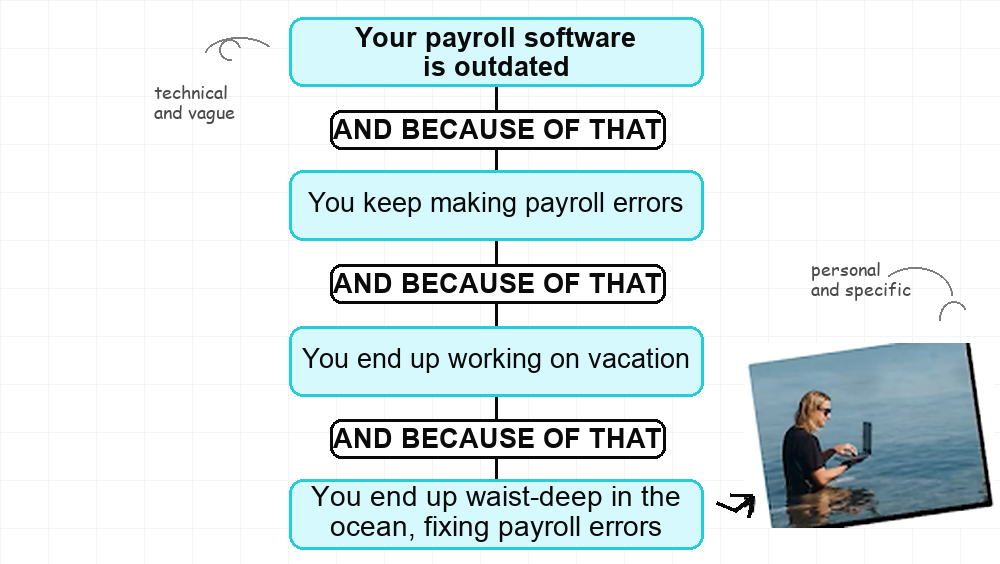
- Step 1: Start with the boring, technical claim every competitor already makes. For his payroll client, that was “your payroll software is outdated.”
- Step 2: Chain “and because of that” onto it, again and again, until the claim turns personal and specific instead of generic.
- Step 3: Keep chaining until it’s genuinely absurd, the point where it stops sounding like ad copy and starts sounding like a bit.
Shlomo’s version: “And because of that, you keep making payroll errors. And because of that, you end up working on vacation. And because of that, you end up waist-deep in the ocean, fixing payroll errors.”
Result: the hook performed 32% better than the average of his other ads. It was made for about $100 using AI, with no traditional shoot. Shlomo says you can make almost any concept this way without a big production budget. You just need a strong concept.
Tactic 2: Say it with an image (visual analogy)
To stop the scroll, an ad has to be instantly clear. Software concepts are often too abstract to show in one frame, so Shlomo swaps them for something visual everyone already recognizes.
- Step 1: Find the phrase customers already use to describe the pain. Don’t invent anything.
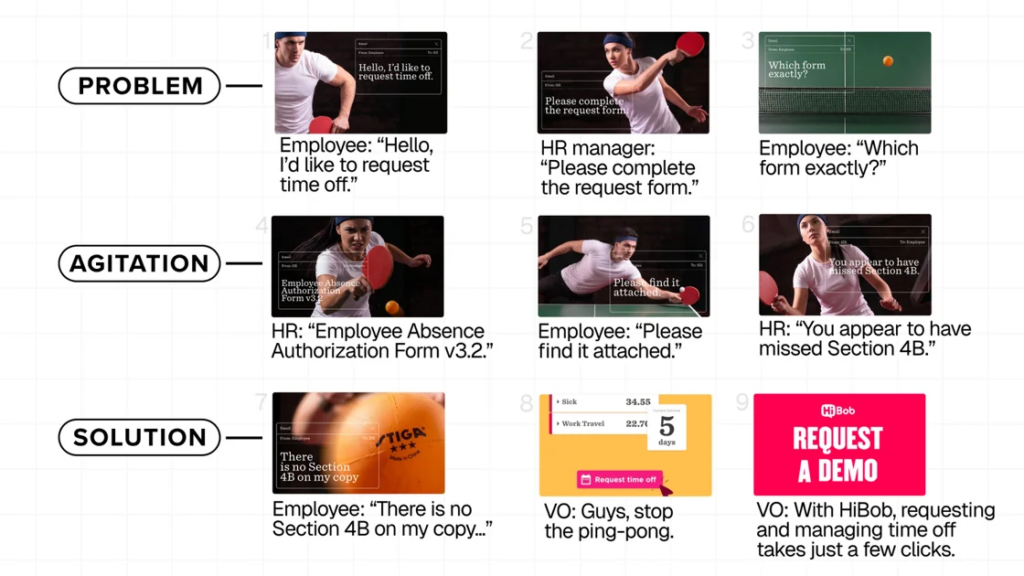
- Step 2: Look for the phrase that paints a picture. For HiBob, HR managers kept describing the endless approval back-and-forth as “email ping pong.” Ping pong is already a visual, so that became the ad.
- Step 3: Storyboard it with Problem, Agitation, Solution (PAS): an employee asks for a Friday off, gets stuck in a maddening form-and-approval loop, and HiBob solves it in a few clicks.
The line every HR software ad runs: “Automate time-off requests and approvals.”
Shlomo’s version: An employee asks for a Friday off. Then form B3.2, then Section 4B, then the anticlimax: “there is no Section 4B on my copy.” And on it goes.
Result: cost per view 53% cheaper than his other ads, and a hold rate 144% above average. The viewers who stayed, stayed almost to the end. He then cut the video into static ads for retargeting.
Do it on a budget: a meme is a visual analogy built on a template people already know. After making hundreds of ads for AppsFlyer, Shlomo says his best performer for them was a simple roller coaster meme, made with AppsFlyer’s designer. All it takes is knowing your customers’ pain points.
Tactic 3: Personify your product and give it an enemy
Personification is Shlomo’s favorite technique. People connect to people, not products, so he turns the product, or its enemy, into a character.
- Step 1: Name the enemy. Not a specific competitor, but a category everyone already resents. For HiBob, that was legacy HR software.
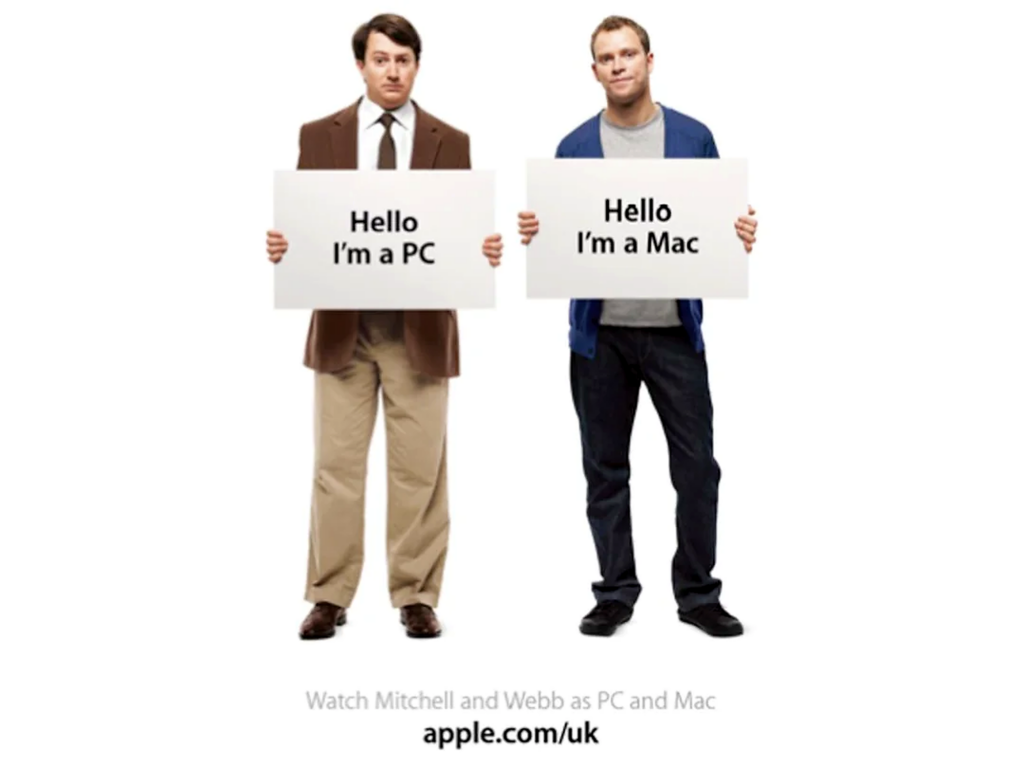
- Step 2: Build your characters. Shlomo took the old Mac vs PC playbook and cast legacy HR as the boring guy. HiBob became the one who is beautiful, smart, popular and, unlike the legacy competition, not a time-waster.
- Step 3: Drop them into a scenario your audience knows by heart. Shlomo picked a soap-opera breakup and skipped the product screenshots and feature lists every competitor leads with.
Result: his best-performing HiBob ad ever, with leads 80% cheaper and views 50% cheaper.
The three creative tactics at a glance
| Tactic | How it works | Shlomo’s example | Result |
|---|---|---|---|
| World without | Chain “and because of that” onto a boring claim until it’s absurd | Payroll errors, ending waist-deep in the ocean | Hook 32% better than his average; made for about $100 with AI |
| Visual analogy | Turn a phrase customers already use into a picture | HiBob “email ping pong” time-off ad | Cost per view 53% cheaper; hold rate 144% above average |
| Personification | Cast your product and its enemy as characters in a familiar scene | HiBob vs legacy HR as a soap-opera breakup | Leads 80% cheaper; views 50% cheaper |
Want to see these ideas in a wider set of campaigns? Browse these B2B ad examples with real budgets and results. The same storytelling rules carry over to video: here is how to approach B2B TV ad creative without a Super Bowl budget.
How to get your boss to approve a creative ad idea
Shlomo admits it’s not always easy to get a fun idea approved. Start by thinking about it from the decision maker’s side. It’s not that they don’t like the idea, though sometimes they won’t. They’re the ones whose budget and job are on the line if it flops, which is exactly why good ideas die in the meeting room.
- Start small. Add one meme to the ad mix for a week and let a small win build the case for a bigger yes.
- Own it end to end. Don’t just pitch the idea. Have the cost figured out, the videographer booked and the timeline set.
- Make it a low-friction ask, so all the decision maker has to do is say yes.
Creative is one part of the plan. Budget, targeting and measurement decide whether a winning ad gets the reach it deserves, so build it into your B2B paid media plan.
Where AI fits in B2B ad creative
Shlomo’s $100 payroll ad was made with AI, but the concept came from research into how customers talk about the pain. As he points out, even the most AI-native companies still cast real people in their own marketing. For more on where AI fits, hear how B2B marketers use AI in creative work, or watch the full interview with Shlomo.
Want more creative plays like this? Subscribe to the Exit Five Newsletter for real stats, examples and tools from B2B practitioners, so you know what’s working right now. It lands twice a week.
Frequently asked questions
How do you make B2B ads for a boring product?
Treat creativity as a repeatable recipe that starts with research. Shlomo Genchin of Unbore finds the words customers already use for their pain, then applies one of three tactics: envision a world without your product, say it with an image everyone recognizes, or personify your product and give it an enemy.
What is the “world without” ad technique?
Start with the boring claim every competitor makes, then chain “and because of that” onto it until it turns personal and absurd. For a payroll client, Unbore founder Shlomo Genchin ended the chain with someone waist-deep in the ocean fixing payroll errors. The hook performed 32% better than his other ads and cost about $100 to make with AI.
How do you find visual ideas for B2B ad creative?
Look for a phrase your customers already use that paints a picture. Unbore founder Shlomo Genchin uses Reddit Answers to surface real customer language. For HiBob, HR managers kept calling approvals “email ping pong,” which became a video ad with a 53% cheaper cost per view and a hold rate 144% above average.
What makes a B2B ad scroll-stopping?
It has to be instantly clear and earn attention before it asks for anything. B2B ad creator Shlomo Genchin replaces abstract software claims with something people recognize: an absurd exaggeration, a visual analogy, or characters in a familiar scene. Even a simple meme works, since it’s a visual analogy on a template people already know.
How do you get your boss to approve a creative ad idea?
To get a creative B2B ad idea approved, start small, like adding one meme to the ad mix for a week, and let a small win build the case. Then own the idea end to end, with the cost, production and timeline figured out, so all the decision maker has to do is say yes.