How This B2B Brand Stands Out Among 200+ Competitors
I’ve been writing a lot recently about how important it is to stand out in B2B marketing – especially now that everyone has access to the same AI tools. Here are a few core principles Ethan Clouser uses to head up marketing at Bland and stand out in the super saturated, highly competitive voice AI space.
1. Use language specific enough to lose people, so your ideal customers know your product is perfect for them.
Ethan told me about a recent voice AI conference he attended where he counted 200 competitor booths. Nearly every booth said some version of “voice AI that drives ROI” or “…that saves you time,” and so on. Same jargon, same value props, booth after booth. He said, “if I’m a prospect, I don’t care, everybody’s saying that.”
So Bland went narrow. Their positioning is five words: voice AI for regulated industries. Clean. Simple homepage experience. Not voice AI for everyone, but dialed into their specific niche: voice AI for the enterprises with the most security and compliance requirements in the world. That’s the play: say something specific enough that one type of buyer sees themselves in it immediately, and the other 199 booths cease to exist.
How Bland does it: Ethan checked recently what AI tools say when you ask about Bland. The pros and cons it surfaces now match their ICP exactly: great fit if you’re a large enterprise with a big call center, skip it if you’re a small business.Not you? See yourself out…
2. Write at a fifth grade reading level, so buyers instantly get what you do.
Ethan shared one of his pet peeves as a marketer: billboards or websites with buzzwords like “AI infrastructure for GTM alliance,” that don’t mean much to anybody. To avoid this trap, his rule for his own team is this: write everything, website copy included, so simple that a fifth grader would understand it. Not because the buyer is unsophisticated, but because the goal is instant clarity. The reader should immediately understand the value you provide.
How Bland did it: One of their most famous campaigns is a perfect example. Bland ran a billboard with three words: “Still Hiring Humans?” No context, no feature list, just a simple question and a phone number underneath so people could call and talk to the AI. It generated over a billion impressions and booked out every sales rep’s calendar for four months. For callers, the simply-stated question drove intrigue, and the value of the product handled the rest.
3. To create viral moments, ideate a lot and kill 80% of ideas before they ship (so the ones that survive actually land).
The focus on virality isn’t new at Bland, it’s baked into the company’s DNA. Ethan told me that before he joined, Bland built its entire early brand and revenue off viral marketing. The guy running marketing at the time was great at coming up with ideas and making sure they got attention. Ethan inherited that culture and built a process that kept that momentum going.
To make sure ideas stay aligned with team goals, each one goes through a filter: would this cause our ICP to stop scrolling, and would they still like us after they did? Ethan said about 80% of ideas get cut right there. It’s not just his call, though. If enough people in the room think a stunt won’t land, it dies, even if the CEO wants it. If the room is genuinely split, they’ll bring it to investors as a tiebreaker.
It helps that the room isn’t afraid to go far. Bland’s two founders started the company in their early twenties and got rejected by 180 investors before they raised a dollar. Ethan says they’ve always hired people like them, “young and scrappy,” on purpose. Bland also stays lean by using agencies for idea generation. He says he can get world-class creative at a fraction of the cost of building it in-house. You don’t have to come up with every idea – you have to be good at deciding what goes live.
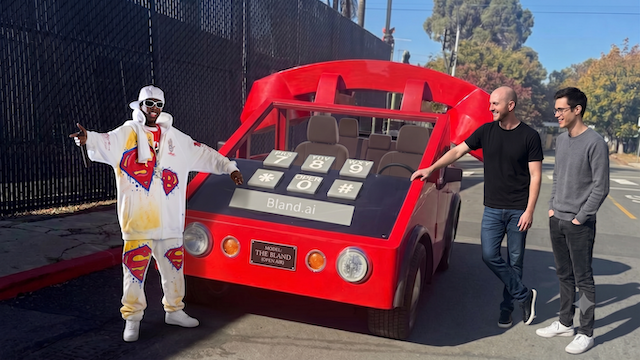
How Bland did it: Bland bought Soulja Boy’s exclusive voice rights so that any customer can automate their calls using his voice (eg, call a restaurant running on Bland and Soulja Boy might take your order.) To announce the partnership, Bland built a street-legal, bright red 1960s telephone car and filmed Soulja Boy taking it for a spin. The video generated 60 million impressions in the first week. Bland saw this collaboration as a great fit, given their ICP is 30 to 50 year old execs who grew up in the internet culture era when Soulja Boy rose to fame. Nostalgia, meet execution.
4. Bring viral moments into other marketing touchpoints, so they keep generating value long after the hype cycle ends.
Bland is actively building out ABM and moving upmarket into enterprise. You might expect the viral stunts to fade out as they get more “serious,” but they haven’t. Ethan says every ICP customer he talks to already knows about the red phone car and the Soulja Boy campaign, two years later.
When asked if all the scrappy, viral energy has to fade out once Bland moves upmarket, Ethan’s answer was simple, “I think we can’t afford to stop.” And the stunt doesn’t retire when the press coverage does. It just changes jobs, from getting attention to driving engagement via sales conversations, ABM touches, and so on. That’s the difference between a campaign and a brand asset.
How Bland does it: The telephone car shows up as Bland’s booth activation at conferences, years after its initial launch, and people still stop to take photos and call the number inside to try Bland for themselves. Soulja Boy came back too. Bland flew him out for a private wine tasting with prospects and customers, turning a viral campaign into an ABM touchpoint.
Ethan sums up Bland’s approach to virality like this: decide intentionally which association you want people to make, then make sure they can’t look away long enough to make it.
For marketers like me that love viral moments and didn’t get into marketing to talk about nurture sequences, or fight with sales over attribution – my conversation with Ethan Clouser is worth a listen.